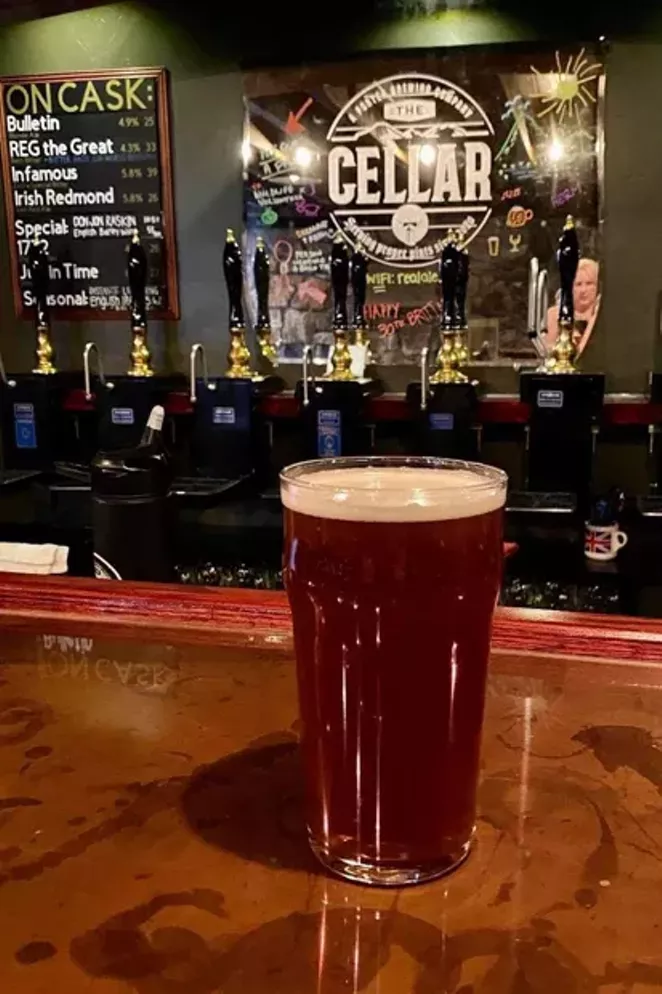
For people who cut their teeth on the early styles of craft beer such as British bitters, can you believe that in late 2021 there are SIX such bitters–the trinity is ordinary, best, and extra special or ESB–on tap or even better, on cask, in Bend right now? Even if you’re an IPA lover, or especially if you’re an IPA drinker and want to taste the original bitter (that’s actually not all that bitter by comparison), order an imperial pint and you’ll see why I’m ESB-Til I Die. Click the link for my latest in Bend’s Source Weekly.
Almost from the first of dozens of mixed tapes I made for friends (and myself) back in the years when an adolescent me made mixed tapes, I’d kick them all off with a different Violent Femmes tune. That idea followed me to college where, during my years of broadcasting on our college radio station, every single show began in the same fashion. Somehow, I only saw them live a small handful of times unlike, say, Flogging Molly, who I’ve easily seen a dozen times beginning with the in-store they did at a punk rock record shop when their debut album came out.
So imagine my delight in having them both perform here in Bend on the same bill (along with another band I really dig, Me First & the Gimme Gimmes). So, despite the preponderance of my stories for Bend Source Weekly covering beer, and nearly all the rest rounding up doughnuts so I can continue to write off all my doughnuts, I pitched my editor on previewing the Femmes show. This story reads more like a love letter and by far the best part about it was having a stranger at the show recite my opening line, “If nothing else, the … Violent Femmes have ensured that (we’re all) able to count to 10.”
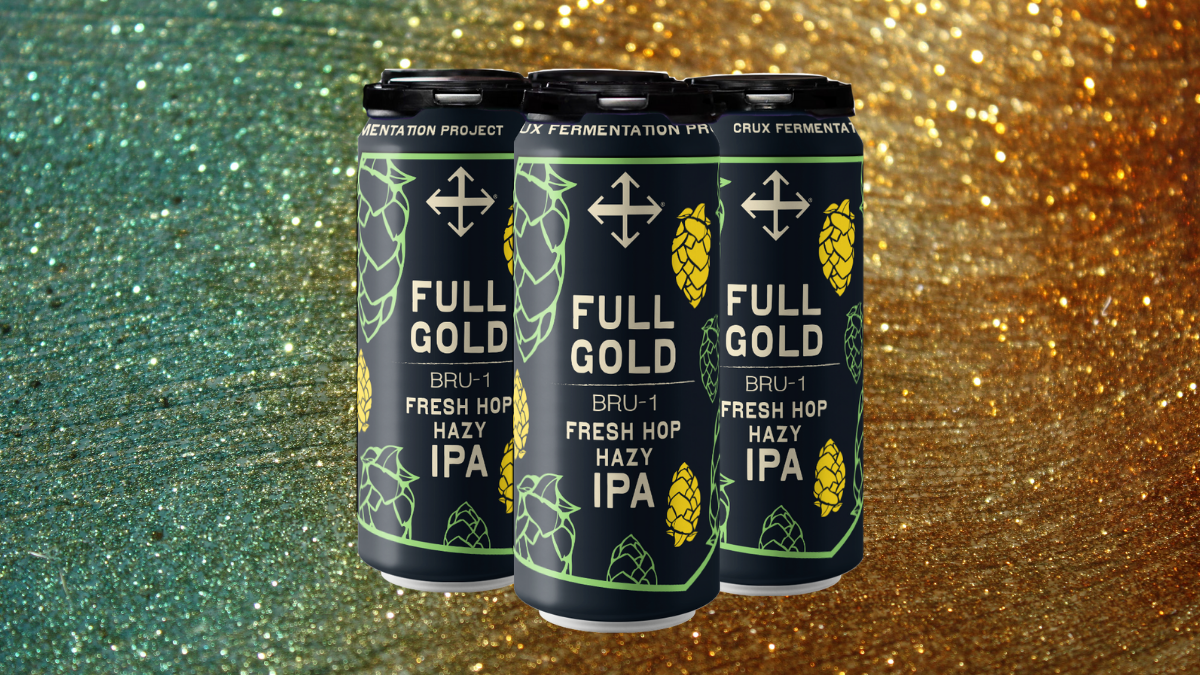
Apologies for the bizarre-titled post but, like the contents of the subject matter, I’ma keep it short. I’d penned this uncharacteristically laconic review of Crux Fermentation Project’s “Full Gold Fresh Hop Hazy IPA” for SIP Magazine. It only cemented my love affair with BRU-1 hops. And fresh hop beers in general. And nabbing a silver at the 2022 NAGBYs in the process.
Those tasting room tap lists can be confusing or mysterious, as can the language and info printed on beer labels, but I’m here to help so that you clearly understand it from top to bottom.
Ever since the Coronavirus stopped the world from spinning, not only have most or all of your favorite beer bars been (temporarily) canceled, but so as The Beer Class at UC, Santa Barbara. But when one door closes, one window or browser opens. From intimate gatherings to larger groups of friends, coworkers, or extended family, both my beer and cider tastings are now virtually available by Zoom. I pick the best possible beverages and you pick them up at your local retailer. I’ve done this for folks from here the Valley to over in Virginia (not just alliteration). Together, we’ll come up with the right theme such as style, region, cheese or other food pairing, or just bottles or cans that scratch your fermented itch.
Please get in touch to begin your journey toward not-simplifying but easily-understanding what makes beer &/or cider so complex as well as so delicious.
Photo by ME, Brian Yaeger, at Jazz Fest 2019. Oh yeah.
This past April, Tom Jones—sorry…Sir Tom Jones (but I like to call him ToJo) who just turned 81—released yet another stunning album. Surrounded By Timeis, quite simply, a masterpiece. Which you’d expect me to say since I’m the guy who ironically went to see him in concert in 1995 (tickets were $7.50), but has since seen him nearly a dozen more times unironically because that first show converted me into a TJ stan. The album he was supporting back then had the massive hit single “If I Only Knew,” or at least it was in Europe, which is why I heard it in heavy rotation in my dorm room during part of my junior year abroad.
He has released eight albums since then and with the exception of 2002’s Wyclef Jean-produced hip hop inflected album (no foolin’), Mr. Jones, each subsequent record surpasses its predecessor and likewise, each subsequent concert I proclaim the best one I’ve seen. (Well, his set at the New Orleans Jazz Fest in 2011 was my favorite set list.) OK, Surrounded By Time isn’t better, per se, than its trilogy of prior discs—Praise & Blame’s bluesygospel, Spirit in the Room’s bluesy folk, and Long Lost Suitcase’s blue-eyed blues—but these last four were produced by Ethan Johns who, it can be said, has done for ToJo what Rick Rubin did for Tom’s old friend Johnny Cash with their American series that saw the Man in Black covering the eclectic likes of Beck, Bono, Danzig, and Depeche.
“Singers are like actors,” said the Welsh Wonder recently. “You don’t have to write the script…in order to make it great or to give it your own interpretation.” This is why I struggle to call Tom’s songs covers. And almost every song he has ever recorded was written by someone else, from his early hit “What’s New Pussycat” by Burt Bacharach to his golden comeback, “Kiss.” Incidentally, June 7 wasn’t just Tom’s 81st birthday; it would’ve been Prince’s 61.
Treatments, reimaginations, recreations, interpretations, or, though it’s a dirty word, appropriations. And in many cases, augmentations. I have two concrete theories about “covers.” Firstly, it’s impossible to cover a Beatles song poorly because at their base they’re perfectly structured pop songs. And secondly, Jones can make even the worst song great; his reimaginations are habitually ameliorations. Take “The Reason” by Hoobastank, written by their then-28-year-old-singer. I hated that song largely because the kid had no life experience so I didn’t believe him. But when I heard Sir Tom sing it (the one and only time I saw him in Vegas, baby), the lyrics rang true. “I’m sorry that I hurt you/ It’s something I must live with everyday/ And all the pain I put you through/ I wish that I could take it all away/ And be the one who catches all your tears/ That’s why I need you to hear/ I’ve found a reason for me/ To change who I used to be.” It’s no secret that the man who’s had more knickers tossed at him than Victoria’s Secret has ever sold wasn’t faithful to his wife, Linda, who he married when the 16-year-olds had their first kid.
Decades later, when Linda was dying of lung cancer, Tom proclaimed he doubted he’d ever be able to perform or record again. According to his account, from her deathbed in 2016 she insisted he find the strength. The first track on his first album since then is “I Won’t Crumble With You if You Fall” by Bernice Johnson Reagon. While Reagon is a Civil Rights activist and was lead vocalist behind the a cappella folk group The Freedom Singers, the song becomes an homage to Tom’s now-late wife, almost as if it were a sequel to the uber-rare Jones-penned original, “The Road” from 2008’s 24 Hours.
The largest departure on this album is that in lieu of a big, tight, brassy band (like his co-headlined disc with Jools Holland), many of the tracks are sparse, avant garde, and atmospheric, yet still theatrical (“The Windmills of Your Mind,” “Ol’ Mother Earth,” “Lazarus Man.”). Several cuts are trance-like electronica. In some ways, it harkens back to his collab with the Art of Noise, absent that bombasticness. And if I think back to the last time I saw him in 2019, he hinted at this with his performance of his compulsory chestnut, “What’s New Pussycat.” It basically it sounded like the organ music you hear on a merry-go-round. It was just such an oddball curveball (Thunderball) type of delivery. It was, like this entire album, transportive.
His best offerings are indeed the songs that seem autobiographical. A staple of his late-era live show has become Howlin’ Wolf’s “Two Hundred Pounds,” altered only slightly since, to hear Tom intone and baritone it, “See? Howlin’ Wolf wrote it as Three Hundred Pounds. Because he was 300 pounds. But I sing Two Hundred Pounds because I am 200 pounds.” And then he goes bass, “Of heavenly joy.” When he sings Leonard Cohen’s “Tower of Song,” I simply refuse to accept that Cohen didn’t pen it FOR Tom with lyrics like, “I was born like this/ I had no choice/ I was born with the gift of a golden voice/ And twenty-seven angels from the Great Beyond/ They tied me to this table right here in the Tower of Song.”
On Surrounded, Tom takes mostly-unknown tracks by well-known artists as well as wholly-unknown tracks by little-known artists. I’d only caught wind of The Waterboys because I like a lot of the pan-UK-folk/rock bands that followed in their wake a la Flogging Molly. Their original, “This is the Sea,” is a fine, even rousing bar-room sing-a-long. In ToJo’s hands, it’s an organic, organ-fueled ballad with a one-man Gospel Tabernacle choir. Churchy!
Tom takes Cat Stevens’ 1970-song “Popstar” and makes it his 2021-own.
Same with Todd Snider’s “Talking Reality TV Blues” from 2019. Said Snider, “Snider says, “Tom Jones is as great as a singer as there has ever been,” adding, “I prefer his version of the song to my own.” Regardless of who’s singing, the lyrics are a think-piece set to a talking blues. It’s a parable, really. At first it warns of the early dangers of television and how video killed the radio star. Wait til you hear the part about the video star. But the gut-punch is the last verse. “Then a show called The Apprentice came on and pretty soon/ An old man with a comb-over came along and sold us the moon/ And we stayed tuned in now here we are/ Reality killed by a reality star.”
It’s the first time I can conjure up where Tom gets political. But then he does it a beat later, or five tracks later, with “Ol’ Mother Earth.” The song was originally written and recorded by a dude named Tony Joe White in 1973. “And now the ones that you have loved/ Are taking you for granted/ Here they’re so enchanted/ By the progress they can make/ They never stop to think/ Just how much that you can take.” It’s like if Greta Thunberg just wrote it.
He takes Bob Dylan’s “One More Cup of Coffee” and does with it, well, much like he did with “What Good Am I?” in 2010 and “When the Deal Goes Down” in 2012 (making this his third Dylan cover over his last four albums). Dylan gave these songs a voice. Jones gives them vocals.
But the show-stopper is actually the disc’s penultimate track, a melancholic yet candid song called “I’m Growing Old” with only a pensive piano as accompaniment. A funny story I just heard is that its writer, Bobby Cole, tried to get the 26-year-old Jones to sing it the year he received a Grammy for Best New Artist! It’d have been like Hoobastank singing about learning the life lessons of a wizened showman. But today, 55 years later, Jones delivers the dark ballad’s lines as if he’s telling Linda to get ready for him. “I’m growing fonder of the fire/ I’m growing mindful of the cold/ I’m growing wise/ I’m growing, yes/ I’m growing old.”
Regardless of the music, his entire oeuvre has been a showcase for his deep, rich voice. The stuff of Mahogany and Corinthian leather. What Surrounded lacks in range it has a deluge of gravitas. With the added storytelling, it makes Surrounded damn near a concept album, The tracking or sequencing is amazing. It harkens back to his early days (his first #1 single, “It’s Not Unusual,” came out in 1964). It also transforms some older material and makes it sound new but also takes new material and gives it a Greenwich Village art house touch where I feel like I should snap to show my appreciation. Then it ends with a retro-futuristic song called “Lazarus Man” by the late soul/jazz musician Terry Callier that simultaneously places Jones in decades past, in biblical times, and in Max Headroom’s 20 minutes in the future.. It paints a portrait of an artist who’s at once past time, show time, surrounded by time, and external to it. On the very sad day of his eventual passing, when the media and most people will want to memorialize him by playing “She’s a Lady,” we ought to put on headphones and realize his music will never die because He’s a Lazarus Man.
Preface/Foreword: I have no idea when I wrote the following! It’s mid-June, 2021 and I just found a mini trove of unpublished blog posts in a newly-found Drafts folder. I don’t remember writing it but I DO know I’ve voiced my hatred for the word “nice” countless times. The post is woefully unfinished; woulda loved to know where I was going with it. But for posterity’s sake, I’m hitting the publish button now. Noice!!
Oh really, you like a nice hoppy IPA or a nice jammy Pinot, do ya? That street dog’s gotta nice snap? That Penang curry’s got some nice heat? Do you flipping hear yourself?? For one thing, when and why did the word “nice” become a substitute for very? (Which is very much one of the dumbest words one can utter and it’s no coincidence that Trumpy uses it… very much.) And more importantly, who Wouldn’t want whatever it is they’re enjoying to be nice? Who the hell would want a so-so beer or a meh wine? Perhaps you think it sounds more polished or hip than saying “good,” but if so, you’re damn wrong. It’s vapid. It’s meaningless. Nice is nasty
Hell, while watching a video about Chinese street food Jianbing by Eater, the eater used the following phrases: “a nice crunch, a nice texture, a nice variant.” He then said, “nice, bright purple cabbage…there’s a nice, sharp ginger flavor.”
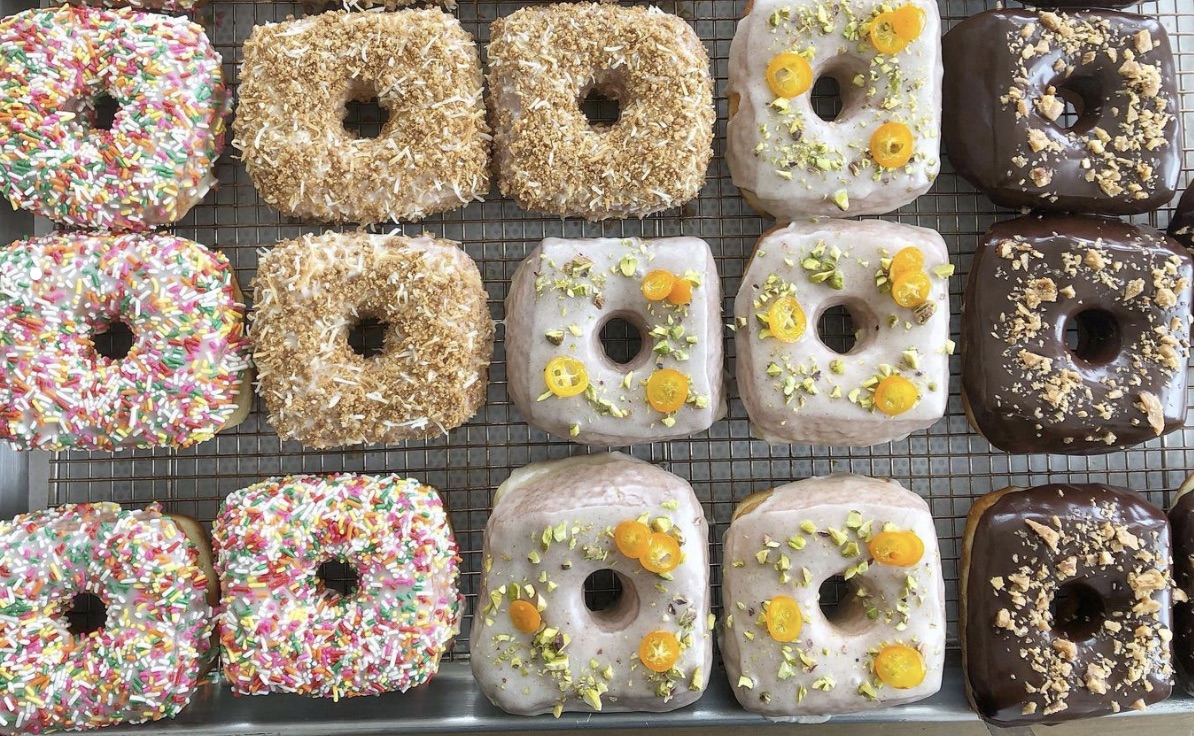
It gives me massive delight that my final story for my local alt-weekly wasn’t on a brewery, but on a doughnuttery. Well, Bossie’s Kitchen is really more of a take-out dinner cafe that just so happens to have a kick-ass bakery that’s quietly one of the best in a town dotted with Francophile sugar shacks. This is my interview with Lauren Herman, the woman behind the doughnuts.
Inspired by his South Korean roots, Tommy Chang wows all with mochi-based doughnuts. | Credit: Daniel Dreifuss
“Tommy” Chang was born and raised in Santa Barbara, but often visited his family in South Korea, where rice cakes are a traditional staple. Whether here or there, “with each visit and gathering, there would always be rice cakes and mochi for everyone to snack on,” explained Chang. “And during the holidays, my mom would typically make mochi squares laced with seasonal fruits and nuts.” Inspired by those experiences, Chang threw himself headlong into making his own mochi treats for the greater Santa Barbara community. His Mōr Donuts weren’t the first mochi doughnuts I’d had, but in short order they grew to be the best, though the name has since been changed to Kin Bakeshop.
It’s not in the realm of doughnuts, but when you’re raised on these chocolaty or cinnamony or sometimes pruny treats found at every self-respecting Jewish delicatessen, you gotta shout it from the rooftop. Or from The Takeout. My love letter to rugelach.
I’m a big fan of the new direction in wine-beer hybrids, in one tiny circle called oenobeers. So while writing a few stories about these beers co-fermented with wine grapes, a few examples from New Braunfels, TX-based New Braunfels Brewing were shipped my way. One beer, Very Seldom Naughty, employed Chenin Blanc and Viognier pomace and was aged in white wine barrels yet still was stashed in the cellar for later enjoyment.
Now IS later. And just as no wine before its time, it seems two years is the right amount of time to lay down this release. When I open these, I always offer Wifey a taste (and her own glass if she likes it). And since she tends to not pull her weight when the bottle contains a big, bourbony behemoth of a beer, I wish that tart, fruity mixed-culture beers like this would roll into her wheelhouse, but she deemed it “too funky.” Which is to show how subjective this stuff is because I found this beer quite approachable. In the vein of a sour witbier or grapey gose, it had moderate tannins and effervescence and generally tasted like something both champagne and lambic fans would both enjoy.
If you’ve never had anything from this Central Texas brewery, this is as good a place as any to start exploring. Oh sure, they’ve got some sour Pickle Juice beers, but if in a contest of funky vs approachability, my money’s on Very Seldom Naughty over the brine.







 Brian Yaeger: Beer Writer