Portraits of Dead Soldiers Left in the Yard: Bad Hombres Edition

Three and a half years ago, evidently, I was inspired to write a series of blog posts inspired by a particular type of infuriating litter I’m always finding in our flower boxes or somewhere near the front yard: dead soldiers. Empty beer bottles and cans. Click here to see the entire “series” (2 posts: BridgePort IPA and Sparks: Blackberry) from my old Beer Odyssey blog. I pick up so many recyclables–both craft and macro–that I’m occasionally inspired to kickstart it back up. But today’s discovery made it imperative.

Some of you know of one of my beery obsessions: nips. Fun fact: a story I wrote about tiny bottles appears as a reference on Wikipedia! And in fact, they were the subject of yet a different blog: Welovenips. That one I evidently pulled the plug on two years ago. It still lives on in Twitter form. (Follow @welovenips for a bimonthly tweet.) So imagine my delight and horror–equal parts–when I discovered these three amigos in said planters.

fullsizerender

This tears me apart. I love cuartitos or chicos, but Corona is my absolute least favorite Mexican lager.  I’m not sure if these bad hombres were smuggled over our open borders or were simply bought at Freddy’s across the street, but clearly someone was thirsty enough for 14 oz but not for 21. Oh, I confess I was tempted to crack open that third one and write a review of a lightstruck Coronita, but I was afraid Dia de los Muertos might arrive 11 days early.

These planters are for succulents. Not sucky beer.

Bodily Brewing Taps Micro Terroir: single-organism fluids

Bodily Br12654105_966186803457786_7032166315431549631_newing will be oozing into and out of a taproom near you soon. When fermented wort no longer catches beer drinkers’ eyes on beer-flavored beer’s merits alone, these Portland, Oregon brewers are turning to fermented warts. The brewery’s focus will not be on kettle-soured beers popular of late, but will push the envelopes by turning to intestinal and bladder soured beers. So if you think they’re taking the piss, you’re right. Their first beer, to be released this summer, is Gose to the Bathroom, a tart, refreshing Leipziger-style gose replacing sea salt with high-salinity urine. It will be followed by the hazy Bile IPA soured with Butyric acid for fans of extremely hoppy and extremely sour beers.

In an era where every possible ingredient has been used in beer from Dogfish Head’s Arctic Cloudberry Imperial Wheat (brewed in Delaware but brewed using the amber berries that only grow in far northern latitudes and are so valuable, blood has been shed over their cultivation in Scandinavia) to Burnside’s Riffle Urchin Ale from Portland (made with, as the name implies, sea urchin gonads), brewers continue one-upping themselves as far as sourcing stunt ingredients. If the joke seems to be going too far, for some brewers, the joke is merely the starting line. In 2012, Denver’s Wynkoop Brewery released this video for their Rocky Mountain Oyster Stout as an April Fool’s joke but by year’s end, the brewery announced it would seriously be brewing a stout with bull testicles. Similarly, last year Shmalz issued a press release on March 31 announcing their fourth cumming, er, forthcoming Circum Session Ale, but it was just another April Fool’s joke. Cut to March 30, 2016 and the schticky brewery announced the beer is no longer a thin-skinned joke. Asked whether or not the hoppy, session ale will contain actual foreskin, Shmalz founder chewed over his response before answering with precision, “Yes, the beer goes with brisket and comes with a bris kit.”

The move toward not just Oregon-based but organ-based and increasingly human-based adjuncts flies in the face of the Bavarian Beer Purity Law known as the Reinheitsgebot—the law mandating that beer only be made with malted barley (or wheat), hops, water, and yeast—celebrating its 500th anniversary on April 23, 2016. In all cases, these beers are in vast difference to the Reinheitsgebot. In some cases, this new breed of beers is in vas deferens. We’re not referring to Caldera Brewing’s Belgian Dark Strong Ale Vas Deferens brewed in Southern Oregon but Bodily’s planned winter release, Man-Milk Stout made with ejaculate. Admittedly, this one is jerked from the pages of New Zealand brewery Choice Bros Brewery who created Stag Semen Milked Stout.

Said brewmaster B.J. McSnotte, “If it salivates, urinates, regurgitates, or pustulates, it’s gonna end up in our beer.” McSnotte then added, “But we’re not gonna do a sour beer made with vaginal Lacto like that Order of the Yoni crowdfunded beer going around the internet. The one that uses the phrase “vaginal swab” and “feel her smell” in the promo. That shit’s just gross.”

Beer review: 10 Barrel’s Riding Solo

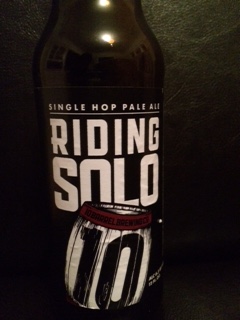
10BarrelRidingSoloAmong my myriad New Year’s Resolutions for 2016 is to do more beer reviews. Between the samples I happily receive on my doorstep, beer travels that find me at different breweries across strange, new lands and just happening upon a new offering at some local watering hole, I want to ensure I’m paying good attention to what I’m drinking.

Seeing as a delivery guy just dropped off a bottle at 6:30 on a Saturday night, clearly it’s time to begin drinking. The beer is from 10 Barrel in Bend (not the 10 Barrel pub in Boise or Portland or the recently-announced forthcoming one in Denver). It’s called Riding Solo and it is, as the name suggests, a single-hop pale ale. Comet hops to be precise. Not that you’d possibly know that from the label copy. It reads: “We could talk about this single hop, but we’d rather talk about Benny, the brewer behind this pale ale. 4 years ago Benny was on the fast track working for a large brewery, and then it all came crashing down. He made a bad choice, climbed the wrong building in Bend and found himself in the clink without a job. We hired him the next day and he has been crushing it ever since. One brewery’s loss is another brewery’s gain. Cheers to the man behind the beer.”

Man is that a strange way to market a beer that theoretically has some educational aspect to it. It shows drinkers the aromatic and flavor profile of the nearly extinct Comet hop, a USDA varietal that I’ve personally never encountered. And anyone who buys this beer won’t know that they’ve had it. (Unless they are compulsive about every beer they try or read my oft-neglected blog religiously.)

Upon cracking the crown I was met with an herbal whiff and I’m only half referring to reefer. At first sip, I was struck by the spicy, dank bitter beer—like a skunk smoked a spliff cut with black pepper and dried grapefruit peel. It falls into the garlic’n’onion descriptor, too. Although they call it a pale ale, it’s orange in color and at 6.8% ABV and 67 IBUs it presents itself like an India Red Ale in malt and hop character. In fact, the spiciness makes it taste like there’s some rye malt in the grain bill, but doubt there actually is because then they’d probably have called it Ryeding Solo.

The Session #107: Are Breweries Your Friends?

sessionAs a precursor, to put this briefly, I’ve been a bad beer blogger. And when it comes to The Session, if I were Catholic, I’d type something like “Forgive me Father, it’s been 30 Sessions since my last participation.” (Click here if you care to see old contributions from my initial blog, Red, White, & Brew) My New Year’s resolution is to be better.

For the 107th ed. of The Session, Dan Conley of Community Beer Works in Buffalo NY asks, a bit self-servingly (wink-wink foreshadowing), “Are breweries your friends?

I say self-servingly because his blog is his brewery’s blog. And it worked. I really wanna try Community Beer Works beer now. And drink their beer and be a part of their community at least for the day. The topic, and hosting this Session, makes them seem, well, friendly. Conley expounds:

“To be in business nowadays you pretty much have to have a social media presence. This is especially true in the beer world, where some breweries have basically built themselves on their personality. And yet, at the end of the day, we’re selling you something.”

Conley continues, “Do you want your feeds clear of businesses, or do you like when a brewery engages with people? …As the person who does our social media…I struggle with this problem.”

My answer is: No.

Breweries are not our friends. Maybe I’m just speaking for myself and should say breweries are not my friends. But unlike Mitt Romney who famously said, “Corporations are people, my friend” (thanks in part to Citizens United), brewing companies are companies and therefore incapable of playing air hockey with me, taking me to a Portland Timbers game (except I suppose their sponsor Widmer Brothers Brewing could), or giving me a card that makes fun of my age for my next birthday. These are things friends do. Friends buy me beer. Breweries make the beer. And even then, what we love about craft beer is that brewers make the beer and, in the best of cases, we know their names and faces. And if you’re lucky, you’re friends with your local brewer(s).

Friendship is a relationship. Indeed, we have a relationship with the breweries that make the beer we choose to drink. And no doubt we have emotions surrounding breweries. In the case of local ones that we support, that emotion may be love. We are passionate about their beer. Given that most of us will never even have a beer from thousands of the 4,300 breweries that exist in the US alone, the emotion we feel for them may be indifference or lack of emotion. And in a few cases where folks feel they’ve been betrayed when a brewery sells out to ABI, a darker emotion courses through their bloodstream. Think about this: would a friend ever sell himself to the house of Bud and leave you high and dry (not that any of us would give up drinking beer altogether, mind you).

Heck, to Conley’s point, we “like” breweries on Facebook, and we delight when we see shiny new fermenters delivered just as we dote over actual friends’ newly delivered bouncing babies. But ultimately, no, breweries are not our friends. They are places we go with our friends. They are places that provide us beer to enjoy as part of our friend rituals. And to succeed, they need to have friendly service. But in the case of social media, I think it’s weird when they have actual personal profiles instead of business pages. I am on the fence about when I see a local brewery’s FB page “like” my pictures. But I’m still happy to tag them by checking in when I’m drinking at them with my friends.

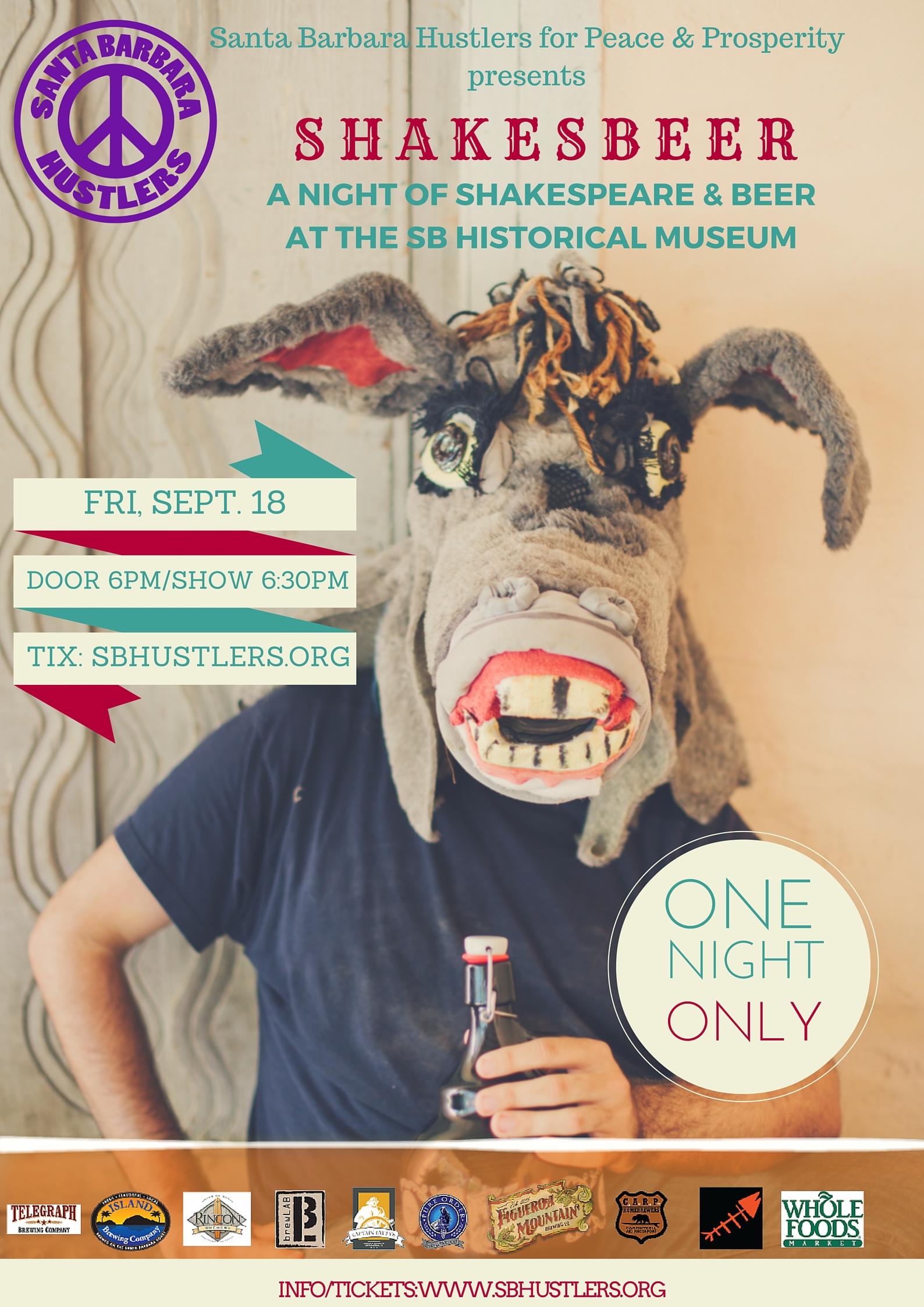
Shakes’Beer (How did Ashland not think of this first?)

ShakesSBeer Poster (1)
All the world’s a beerfest, and all the men and women merely hustlers.

Well, not all the men and women, just primarily four. Zachary Rosen is a Certified Cicerone—the beer industry equivalent of a Sommelier—and on September 18 he’s going to pair Santa Barbara area beers with the Bard of Avon. David Holmes is a theatrical director. Cecily Stewart is a professional ballet teacher. And Matt Turner is the co-founder of the Santa Barbara Hustlers for Peace and Prosperity, an approved project of the Share The Wealth Foundation that provides volunteering opportunities for those interested in becoming more engaged with their local community.
Shakes’Beer, a one-night event hosted at the Santa Barbara Historical Museum, seems more befitting of Ashland, home of nearly-yearlong Oregon Shakespeare Festival as well as breweries Caldera, Standing Stone, and Swing Tree.

The fundraiser is billed as “Shakespeare in the Park meets a beer festival pairing beers with different Shakespearean characters and themes.” With Holmes directing scenes and monologues and Stewart directing “interpretive ballet and an Elizabethan dance session,” Rosen directs the theatre-in-the-round of beers. He styles himself as a specialist in abstract beer pairing events, often combining beer with music and art. He got eight local breweries to design ten unique beers for the event, each one reflecting a different character. For example, Romeo will be liquidly portrayed by brewLAB’s Red Purl Saison (brewed with Perle hops, wormwood, orange peel, and licorice root) opposite Ricon Brewery’s Juliet played by a comely Belgian IPA adorned with hibiscus, vanilla, and orange peel. A beer like Telegraph Brewing’s ode to (Gingered) Julia from Two Gentlemen of Verona and (Bonny) Kate from Taming of the Shrew would certainly break a leg seeing as it’s a Witbier with fresh ginger, pineapple, and Scotch Bonnet peppers.

Even if there are other “Shakesbeer” events such as the Shakesbeer Fest in Stratford upon Connecticut benefitting the American Shakespeare Theatre and another held at The Discovery Center of Murfeesboro, TN, if the SB Hustlers really want to make the world a better place through altruism, they can volunteer to bring their Shakes’Beer at least 650 miles north up to Oregon. I nominate StormBreaker to brew a Trinculo from The Tempest and Baerlic to make Iambic Lambic.

Lagunitas, Heineken, and post-craft beer

urlToday’s bombshell news via Beerpulse, that Lagunitas Brewing founder Tony Magee sold half his baby to the Dutch beer conglomerate Heineken rings more like one of Bang Snaps (aka poppers or throw-downs). A bit startling since it landed at our feet, but it’s not like Tony didn’t warn us that he was throwing one our way for the last few weeks (via his Tumblr blog)!

My 2¢ on the matter: Good for you, Tony. Now that you’ve sold 50% of your brewing company, welcome to being semi-retired.

As Mr. Magee put it himself in today’s post that is required reading before anyone says one flipping word about this matter, he’s “55 years old going on 80.” I have a hard enough time going to the market to pick up a roll of paper towels and I’m 14 years younger.

Lagunitas is America’s sixth largest “craft” brewery. It’s reportedly valued at…are you sitting down?… One Billion Dollars. Last year they brewed some 600,000 barrels. Four years ago before the Craft Brewers Conference, Tony told me that the five largest craft brewers rake in 45% of the craft segment of the beer industry. That was before Yuengling’s status was reclassified by the BA’s board members as being “craft” despite the fact that they’ve always upheld the BA’s three pillars of craftdom: being small (only in comparison to the Big Two of ABI and MillerCoors), traditional (hello! America’s Oldest Brewery), and independent (it remains in the hands of the founder’s sixth and seventh generation descendants).

Soon, Lagunitas will have a third brewing facility online in SoCal after the original in NorCal and a second in his native Chicago. And soon, they will be brewing well over a million barrels a year, which is still well below the BA’s definition of small which presently stands at 6 million bbls. However, their definition of independent is no more than 25% ownership by a major brewing concern. Heinie is a major brewing concern.

Ostensibly, this means that the next time the Brewers Association announces craft beer’s market share, the numbers will reflect lower than anticipated numbers. It will be a setback for the goal of 20% market share by 2020 because they just lost the projected million barrels that even the thousand new brewpubs and nanobreweries combined can’t account for. But don’t you dare blame Tony for pursuing the American dream. Love him or hate him–and there are plenty of folks in each camp–dude’s worked his ass off. He deserves this success. And in his astoundingly articulate, erudite, and strategic manner, the Nietzsche-esque stoner “madman” from Petaluma has neither “come too soon” nor too late. His ship arrived at the exact right time. The industry will keep sailing with and without Lagunitas, a subsidiary of Heineken International, as this just further demonstrates that we are drinking in a post-craft beer world.

Feel free to mumble in the comments below.

Documenting Portland’s beer culture

Two weeks ago McMenamins Mission Theater hosted a screening of It All Starts with Beer, a Dutch-made film about the beer cultural exchange taking place between Dutch and American brewers—primarily ones from Utrecht not far from Amsterdam and here in Portland as part of the Portland Utrecht Network (PUN intended). The film and the screening were made possible, in large part, to Dutch brewer and artisan Rick Nelson from Oedipus Brewing and Portland-based PUN president Greg Raisman. Plus, of course, none of it would’ve been made possible without Cascade Brewing founder Art Larrance and the Oregon Brewers Fest that he co-founded 28 years ago.

I was invited to speak on the panel following the beautifully-shot documentary simply because I had the good fortune to be at the right place and the right time, that being Holland in 2014 for a front row seat as their craft beer culture took a giant leap forward to the point where industry members call their scene “20 years behind Portland’s.” (For Larrance’s part, he tried to persuade me to move to Utrecht, not Amsterdam, because of how cool their brewing scene is, which nowadays benefits from the proximity and relationships with Amsterdam’s community.) Keep in mind there were already almost 20 breweries in these parts back then.

But this Saturday, I’m jumping from the panel into the doc itself. I’ll have a back row seat in the car, cars, or van that will transport John Lovegrove and filmmaker Thom Roholt to 77 breweries throughout Portland Metro. Portland? Why John? Why 77?

Lovegrove is the underground local legend who quaffed a half pint at all 34 breweries in Portland in 2009. Yes, he blew hopped chunks by the end! Two years later he surpassed his own stunt and found himself at 50 in a single day (and spewed at the end again). Fifty, today, seems more doable (not recommended, just doable) considering the clusters that have sprung up in areas like Buckman and Boise and the Pearl. Heck, Oregon City has three operating breweries today (and soon five) that didn’t exist the last time Lovegrove and Roholt undertook this most epic of pub crawls. As for the number they’re attempting in four days and the reason I’m along for the ride, vowing to drink just 1-oz of a house-brewed beer at each stop: I’ll simply be LiveTweeting the ordeal. RIP City!

Speaking of financing, Roholt’s documentary, which is about the who, how, and why PDX became Brew City in the first place and not about the foolhardy pub crawl, is accepting pledges on the website, PDXBrewCity.com. The IndieGoGo crowdsourcing campaign is raising funding for the film itself. The top tier donation includes a mini version of the crawl, to three area breweries, where patrons will undoubtedly get to enjoy more than a total of three ounces of the stuff that makes Beervana “Brewtopia,” I mean that makes Brewtopia “PDX Brew City.”

As for the 77 part. The film will be tied together with a world record attempt at visiting 77 breweries in one day because A) we can and B) the 1977 NBA Champoinship Trail Blazers emblazoned this city with the Spirit of ’77. #Spiritof77Breweries!

Lastly, why do I even get to tagalong? Because I vociferously doubted their ability to complete the 77 brewery challenge but upon realize I couldn’t talk John out of it, I talked myself into it. It’ll be a great way to hit a handful of the area’s newest breweries that weren’t open in time for Oregon Breweries and that I haven’t even been to yet such as Back Pedal, Red Ox (Tigard), Oregon City Brewing, nearly all of the ones in Vantucky, and, the newest among ’em, adjacent to Back Pedal: Splash Bar!

Hope to survive to blog about the experience.

Merc-iful

Another round-up of Merc blog posts:

Over a Pint with Drew Phillips of McMenamins Crystal

IMG_1088As a beer writer who really writes about people, the idea for this Over a Pint series (for me and all beer bloggers who’d like to join in on last Mondays) is to go out for some beers with a brewer and have a conversation beyond the parameters of what’s going on in the world of beer. Sort of in the vein of The Session but with just two instructions.

  1. Head out with someone who brews for a living and talk to them over a pint (or more) without recording it or taking any notes. Just chat. About stuff.
  2. Don’t do it at the brewery’s pub or tasting room.

Let’s begin.

Name: Lloyd “Drew” Phillips

Brewery: McMenamins Crystal Brewery

Professional brewing experience: None prior to McMenamins

I spied the following tweet from @TheMetalBrewer:

https://twitter.com/themetalbrewer/status/598639707417804800

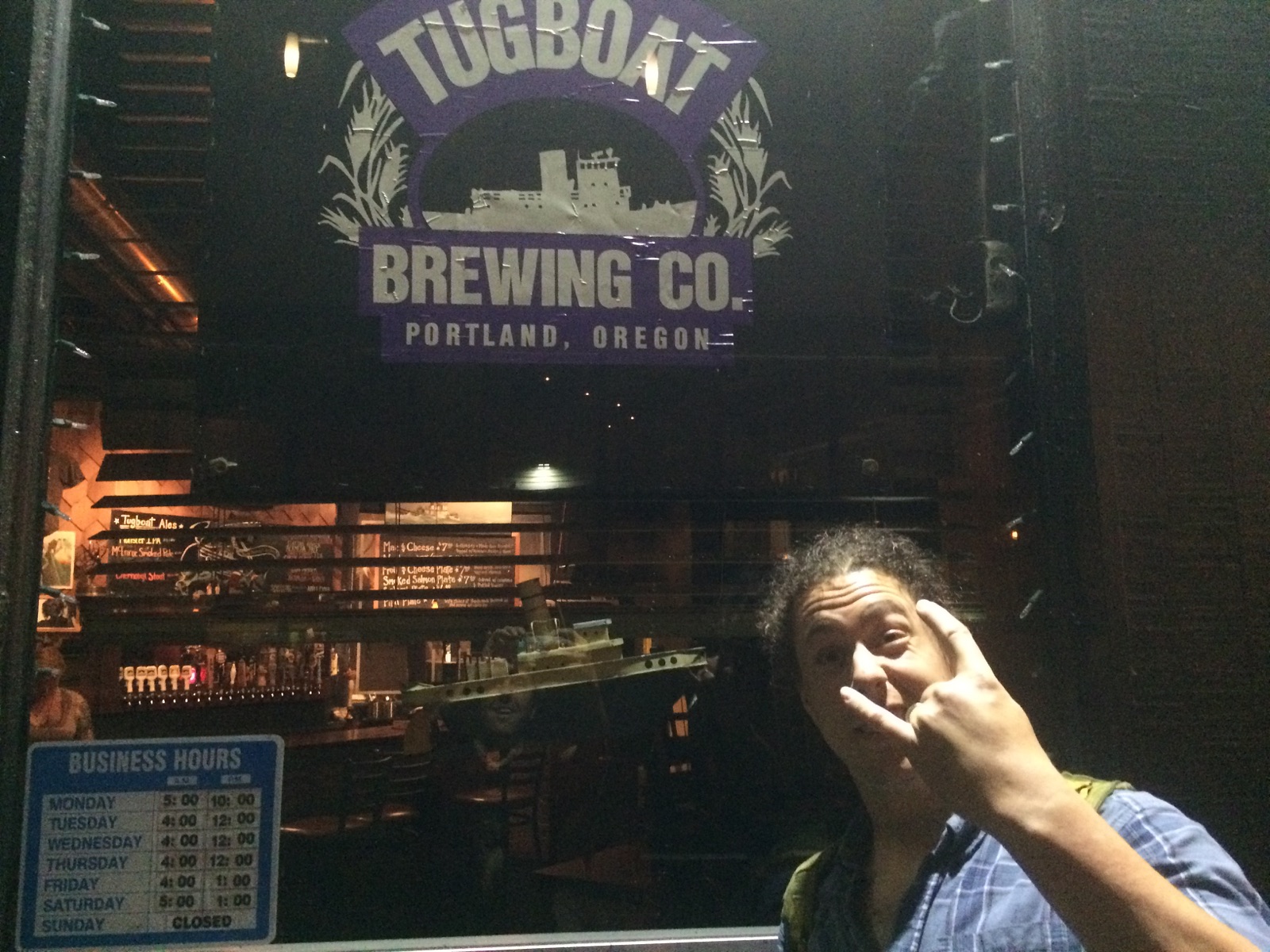
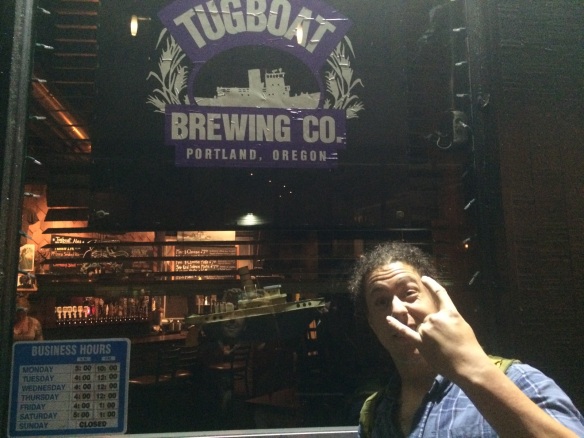
I knew I’d found my next subject for “Over a Pint.” It’s not for me to say the Tugboat is “the coolest” brewery in town, it is PDX’s most mysterious, misunderstood, and maligned. Perhaps you’ve never been. It’s directly across the alley from somewhere all local beer geeks go, Bailey’s Taproom, home of, as the Tug’s owner Megan McEnroe-Nelson calls their clientele, “the beer sniffers” for the way they fuss over chalices. The Tugboat isn’t necessarily a beer Mecca but it does offer the warmest, most inviting atmosphere, which is why @TheMetalBrewer suggests patrons prostrate themselves. (No, not examine their own inner sphincters but essentially genuflect at their Altar of Ambiance.)

It’d be more fitting to call this month’s feature “Over a Half Pint,” at least on my behalf. That’s because the Tug’s best beer is Chernobyl Double Imperial Stout, a 13.5% beast that belies its ABV, that the beertenders are instructed to only sling by the half pint. Over the course of the night, I enjoyed four such halves. The Metal Brewer is Lloyd “Drew” Phillips, a member of McMenamins’ stable of brewers since 2012 who, in company fashion, worked his way up from non-brewing gigs at pubs such as Kennedy School and East Vancouver. He does love metal. But, a perk of brewing at the Crystal is that he gets to attend any of their shows like the recent triumphant return of Sleater Kinney. For his part, Drew drank exclusively Black Sheep Ale, a British import pale ale.

It’s a fitting brand for him. But from what I’ve gathered about Drew, he hasn’t been branded a black sheep but relishes standing out from the herd. As a brief set-up, I arrived at the Tug before he did and, in true Tug fashion, struck up a conversation with a guy named Troy who I sat next to. (OK, it’s “whom,” but I hate that word.) Troy, a homebrewer, was in town on business from Nashville. Drew lived in Nashville and spent a decade in Tennessee though he’s originally from Charlotte, NC. Anywhom, Drew and Troy then engage in a conversation, mostly about brewing for McMenamins, and he uttered this great quote that I’ve possibly mixed up by a word or two. “I’m in Italy, but I’m like the Vatican.” It was a dictum on his and all McMenamin brewers’ autonomy to brew whatever they like save for those famous beers such as Ruby and Hammerhead. But is that so different than any other brewer with big-selling brands that are equally treated as sacred cows?

Drew is one of the company’s most creative brewers. He wrote the recipe for Lord of Misrule, the rum-aged Mexican Mocha Imperial Stout that had many local beer tastemakers (1, 2, 3, 4, 5) scratching their heads that easily one of the best beers at last year’s Holiday Ale Fest came from McMenamins. I also recall that he co-created the “Cerberus” program—a series of wild ales now being made at Edgefield—that underscores the unique barrels McMenamins’ brewers have access to since they also operate two distilleries. Incidentally, Cerberus was the name of the family dog in my 7th grade Latin book–yes, I studied Latin in junior high–that perished with the family at the end when Mt. Vesuvius erupted. Only later would I learn how great the name was, akin to the claymation pooch in that innocuously Christian kids show Davey & Goliath, since Cerberus is the three-headed dog that guards the gates of Hades in the underworld in Greek mythology. I vowed to one day name a dog Cerby (“Kirby”), which I did, but it turned out that the rescued pitbull was, sadly, too aggressive and I had to give him back. That’s what I get for naming him after a hell-beast I guess.

As if to hammerhead the final nail in the coffin, Drew is scheming a new beer event that I’m confident will become one of the best in Beervana, or at least one of the most talked about, or at the very least one that will be deserving of those banners. We talked about it quite a bit at the bar, but we talked about a great many other things like music and Tugboat itself and how he just figured the “McEnroe Smoked Pale” that was one of only three house beers on tap was named for the tennis great who was both pale and renowned for his ranting that’d lead to figurative smoke coming out of his ears when really it’s named for Megan’s family although, I did find out that her father’s name is actually John McEnroe. As a side note, one of my favorite beertenders in town, the Tug’s very own Linsel Greene (whose father, David, earned the Emmy award that now adorns the pub’s mantel) wasn’t on duty but Megan’s…sibling…or in-law is the barback and the beertender of the night just so happened to have worked at the Crystal Ballroom. Like all Tug staff, she’s pretty cool and kindly poured me a sample of the smoked pale ale which I didn’t order for obvious reasons but I did start off with a pint of the IPA just to try something different. So, that, coupled with those Chernobyls, is why I didn’t recall details of Drew’s festival-in-the-works and now rely on some cheat notes he emailed me at my request.

The event, Sabertooth (#SabertoothPDX) is actually the 2nd annual and will “pay homage to Crystal Ball era,” said Drew, and keep in mind it’s where the Grateful Dead played even before the McMenamin brothers—who were and are huge Deadheads—bought it. If you didn’t hear about it last year, that’s because tickets are super limited, maybe as many as 300 this year. He continued, “The point of ‘psychedelia’ was then and is now to expand the mind, often pushing yourself into uncomfortable places to do so…We’re trying to create an interactive atmosphere that speaks to all the senses and hopefully expands some minds.” Beer-wise, attendees can expect anything but normal. No flagships. No IPAs or even accepted beer styles. “The more the beer violates or confounds BJCP standards, the better.” But it’s as much about the experience as it is the beer. “Small groups will be led through the 1st Temple of Blasphemous Sacc-rifices (working title) and will be further ‘initiated’ with some sort of fermentation-based activity at each sample station.”

For as “weird” as we pretend we keep this place, there’s a lot of homogeneity. Through Drew’s brews and more, he’s doing his part to alter that.

Field Guide to Drinking in America Book Review

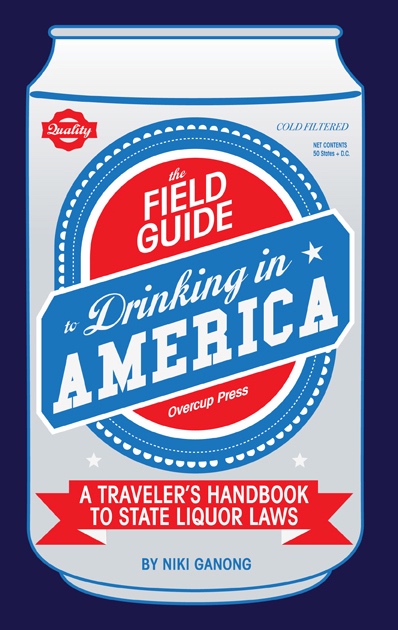
FIELDGUIDE.COVER_hiresThis is a book review about Portland author Niki Ganong‘s new book, The Field Guide to Drinking in America, but this is my blog so I’m starting with a story about me.

So I’m in Pittsburgh with a whole day to explore and drink up the culture. My primary beer stop was Church Brew Works, a righteous brewpub where parishioners, I mean patrons, break bread and hoist pints in a deconsecrated church. The other beer I really wanted to try wasn’t actually brewed in Pennsylvania, but I’d read it was newly available there. If Church Brew Works’ beers are a little slice of heaven, the other one would be a little slice of pizza. Mama Mia’s Pizza Beer. It’s a homebrew recipe using real pizza and ingredients that is contract brewed and bottled and, well, I just had to know. My hunt took me to beer bars and Italian restaurants, none of whom had heard of it. An internet search led me to a place that carried it and I GPS’ed my way to a beer distributor’s warehouse (different than the state-run liquor stores) where they had said pizza beer but they would not sell me a bottle. Instead, if I wanted it, I had to buy the whole case of 24 bottles.

In the end, I had 23 friends back home who were more than happy I went through the effort, but I wish I had a resource like Ganong’s new title, The Field Guide to Drinking in America: a Traveler’s Handbook to State Liquor Laws.

It’s the subtitle that gives this book from local Portland author Ganong its prime practicality. If you’re over 21, you’ve likely learned the ins and outs of your home state’s liquor laws. You know what time the bars close, where you can drink (slash: where you can’t), and if you can find your beer, wine, and spirits under the same roof or not. But when you’re traveling (which means, by default, when you’re drinking someplace farther from home), deciphering the regulations often causes some headaches. For example, how much does it suck being in Colorado, home to even more great breweries than Oregon, but not being able to find most of the beers you’re trying to track down because they’re above 3.2% alcohol by weight (yes, ABW, which is roughly equal to 4% ABV) so what you’re left with is specially-brewed/watered-down for Mountain State markets Colorado and Utah.

I’m not alone in these discoveries. A point made in the book’s intro about the head-scratching, state-by-state laws enacted following Prohibition, “Many a surprised traveler has been caught off guard by an unexpectedly early last call, a sad and liquorless Sunday, or the choice of 3.2% beer or nothing at all. Almost everyone has a story about this.”

Tips and factoids, including a handy-dandy list of “What you can do” and “What you can’t do” in each state that drink-seeking travelers would pick up from the Field Guide:

Vermont: You cannot purchase a second drink if you have not finished your first nor participate in a game or contest that encourages excessive drinking. (Sorry UVA underclassmen.)

Alabama: This Southern state has some of the restrictive liquor laws in the union (they one they’d probably like to secede from again). Of its 67 counties, 25 are dry, though not completely: private clubs are allowed to sell to consumers and each one has at least one wet city.

Louisiana: God bless Louisiana and it’s 24/7 bars and open container laws and drive-thru daiquiri huts.

Tennessee: More than a third of its counties are dry but that only prevents the sale of alcohol, not the bootlegging of it. Interestingly, those dry counties “tend to have higher DUI arrests than wet counties.” The Jack Daniels Distillery, the oldest in the USA, is in dry Lynchburg. Unlike when I visited, now visitors are able to buy a commemorative bottle of JD’s sour mash whiskey but only at the gift shop. Fun bit of trivia: Mountain Dew was invented in Knoxville and originally featured the character “Willy the Hillbilly” firing his shotgun, possibly at another moonshiner, with the tagline, “zero proof hillbilly moonshine.”

Colorado: You can’t buy Santa any beer over three-two to persuade him to add you to his Nice list, nor can you beg for booze.

Incidentally, readers might even pick up some points of interest about their home states. I learned that here in Oregon, I cant bring an unfinished bottle of wine home from a restaurant and that I cannot use a beer bong in a bar (or surf while drunk, not that I’m able to surf stone-cold sober).

Niki Ganong will be at Belmont Station’s Biercafe on Saturday, May 2 from 1-3 p.m. selling and signing copies of her book. She’ll also conduct a tasting of IPAs from across the country. Come sample her selection of some of the country’s best IPAs — including Boulevard’s just released The Calling IPA.