19 beers of the 19-day #covid_19 ‘antine: Paper Edition

Yesterday’s bottle (Fifty/Fifty Eclipse) wasn’t the only bottle I’m still holding dating back to 2009. This is from Placentia, CA’s The bRUEry and the name, Papier, kicked off its ongoing series of bbl-aged anniversary beers named for traditional anniversary gifts (but in French, like the name Rue itself).

I’d discovered The Bruery right after they debuted when my friend and roommate at that year’s Great American Beer Festival, Jesse Friedman (who was still a couple years from co-founding Almanac Brewing), dragged my then-girlfriend and I to their booth on the GABF floor. Patrick Rue and his wife, Rachel, tasted me on their offerings which were pretty mind-blowing at the time. I mean, Black Orchard, a Belgian White Ale but black!? And a Belgian trippel with Thai basil in it!? Not to mention, a saison. Saison was the 2014 gose of 2008. Oh yeah, I also tried a beer the brewery would soon be bottling, a near-20% ABV bourbon-aged imperial stout called Black Tuesday.

Papier is the only beer in the ongoing anniversary series that isn’t made in the solera method (of blending newer stock into the older). Chiefly, because there was nothing older with which to blend (although it is a blend of 25% bourbon-aged Old Ale and 75% “oak-aged” though I’m not clear on whether that means old ale aged on oak chips or in some non-bourbon cask or whatnot. Papier, at this point, is an apt word since, yes, the 14.5-percenter has gone a bit papery. This is, after all, the 11th anniversary of this 1st anniversary beer and oxidation–even in a wax-dipped bottle–will do that. Still, the malt makes for a decadent after-supper sipper and the booziness does likewise. Once again, I was unable to polish off the bottle by myself and the chalice I’d rested on my nightstand perfumed my dreams. It literally made me wake up and think about last night’s beer first thing this morning.

The journey of The Bruery over the last dozen years has been, as Paul McCartney put it, a long and winding road. First the Rue family tree grew by a daughter. Then the Bruery family started selling sour beers under the Bruery Terreux label, and then non-Belgian, non-aged beers under the Offshoot imprint. Then, of course, the Rues sold a majority share to private equity, which enabled them to move from Orange County to Grape Country, Napa, where they just launched Erosion Wines. Pretty bad time to start a new business, but hey, if anything’s gonna get us through this pandemic and quarantine, it’s wine and beer.

Of course, seeing as Bruery bottles occupied an entire shelf in the beer cooler, this means I’ve got 11 more including my now-last Papier, Cuir-Bois (2nd-5th anniversaries), a couple from the 12 Days of Christmas series dating back to ’09’s Two Turtle Doves, several sours, and, of course, some variants of Black Tuesday. If the quarantine warrants a second 19-day cellar-clearning (and sadly it probably will) look for The Bruery to be featured again.

So I raised this glass to that nice young couple who branched out from beers that were the norm of the mid-aughts craft beer scene and started to make the kinds of beers they wanted to see and became quite influential in the process.

NewSeries: 19 beers of the 19-day #covid_19 ‘antine.

Projects. If there’s one good thing that comes out of this Novel Coronavirus pandemic of 2020 is that it’ll be remembered as that time we all GSD. All the home repairs we always vowed to do “someday,” the books we’d bought but never read, the bingeable shows we meant to watch, the time we wished we had to spend with our kids, the longer walks we pretended were around the corner, now is the moment we’re actually Getting Shit Done.

One of those, for me and many a beer geek I know, is finally drinking down our beer cellars.

The bottles we’d held off for some celebration that didn’t seem to come (5 or 9 years back). The bottles that got pushed to the back and since out of sight means out of mind we’d just forgotten we even had that amazing looking thing. Whatever the reason, it’s dusty and forlorn and yet it may be brilliant still so since if there’s another thing a pandemic is good for it’s reminding us that we’re here for a good time, not a long time.

I kinda doubt this extended isolation will only last 19 days, but in honor of this COVID-19 virus that’s stopped the Earth from spinning, I’m gonna drink/document 19. Starting with this purple-wax-dipped bottle of Eclipse Imperial Stout from 2009, emanating from Fifty/Fifty Brewing in Truckee, CA in Lake Tahoe.

I bought this while living not too far from there in San Francisco, probably at City Beer Store. Furthermore, I never would’ve bought it if it wasn’t for something my then-girlfriend did for me just a year earlier. She busted through my self-imposed price ceiling on any given bottle of beer which had been $20. But, while in Chicago on my cross-country book tour promoting Red, White, & Brew, which was her last stop before flying home, we went to an awesome wine shop across the street from Barbara’s Books where I’d done my reading/signing and she bought me a bottle of Naughty Goose, a bourbon-aged imperial brown ale from the local, independent brewery Goose Island. It cost her $30. Outrageous. And also, permission to move my own cap up that high when necessitated. I don’t recall for sure, but I think I dropped $25 for this 22oz’er in ’09 and kept buying a couple bottles each year until the price tags reached over $30. And now, there are so many such barrel-aged beers in my cellar that I’ve stopped amassing them altogether. I noticed that Fifty/Fifty switched from bombers to 500ml packages, which is smart. I confess in advance I didn’t even finish this bottle, but think I got 16 ounces down.

And this barrel-aged number from Fifty/Fifty felt so necessary. In an era when next to no craft breweries had yet developed a barrel program of any note, Eclipse had debuted a couple years earlier. What I didn’t know at the time was that I’d get to write about it a year later and, more interestingly, the man-behind-the-scenes who made it possible. This profile of Tom Griffin, a man known to select brewmasters from coast-to-coast as The Barrel Guy, remains one of my most favorite stories I’ve ever written. (And frankly, since Draft Mag is long gone, I can’t believe the link still works.)

So Eclipse is in the pantheon of bourbon barrel aged beers but back in 2009, it was the first year the brewery even released various versions and used the wax color to denote which specific barrels were used for maturation. There were 3 in ’09. Last year they released 17 editions and, being ’19, one’s aged in Yaegermeister barrels while one’s a pastry stout emulating banana fritters. But this bottle I’d saved to kick off the 2020 Quarantine was aged in Elijah Craig barrels, one of my fave bourbons.

Either despite or because of the 11 years that have come and gone, the beer was a little languid but a lot lovely. Viscous and semi-flat, it oozed with a richness messieurs Penzzoil and Valvoline could only dream of and I do mean the sense of being rich, not of being crude and oily. Lava cake, Little League catcher’s mitt, and damp tobacco leaves rounded out the heady brew. It cast a shadow over most such BBA-RIS libations I’ve had in its wake.

I’m now on the lookout for some sub-$20, 500-ml variants of Eclipse 2020… if we’re around by the time it comes out.

Still on tap: Modern Times’ Nectarnomicon

Photo courtesy of Modern Times

In San Diego where Modern Times Beer started, sought-after kegs tend to kick quickly. Same for larger cities where it operates tasting rooms and pubs such as L.A. and Portland. But here in Santa Barbara at the Academy of Recreational Sciences, beers tend to stick around a bit longer. Because SB.

Also at MT, when a beer has the word “dessert” in the description, you should usually expect a beer that’s terribly rich and wonderfully sweet. A barrel-aged imperial stout brewed with some combination of vanilla beans, coffee grinds, coconuts, cinnamon sticks, cacao nibs, and macadamia nuts that tops 13 percent alcohol is the Modern Times normal. 

So with the fact that Nectarnomicon is billed as an “ultra-fruited dessert sour,” there are a host of surprises to unpack in the beer, starting with the fact that it tiptoes in the tulip glass at 3.6 percent ABV. But Nectarnomicon, with the present keg on at the taproom being the Maui Wowie Edition, is no subtle session ale. It’s more accurately a glass of pineapple and mango juice with a hefty dose of coconut and nutmeg (remember, this is a dessert sour ale) with some fermented malt juice blended in. And it’s delish — morning, noon, or night.

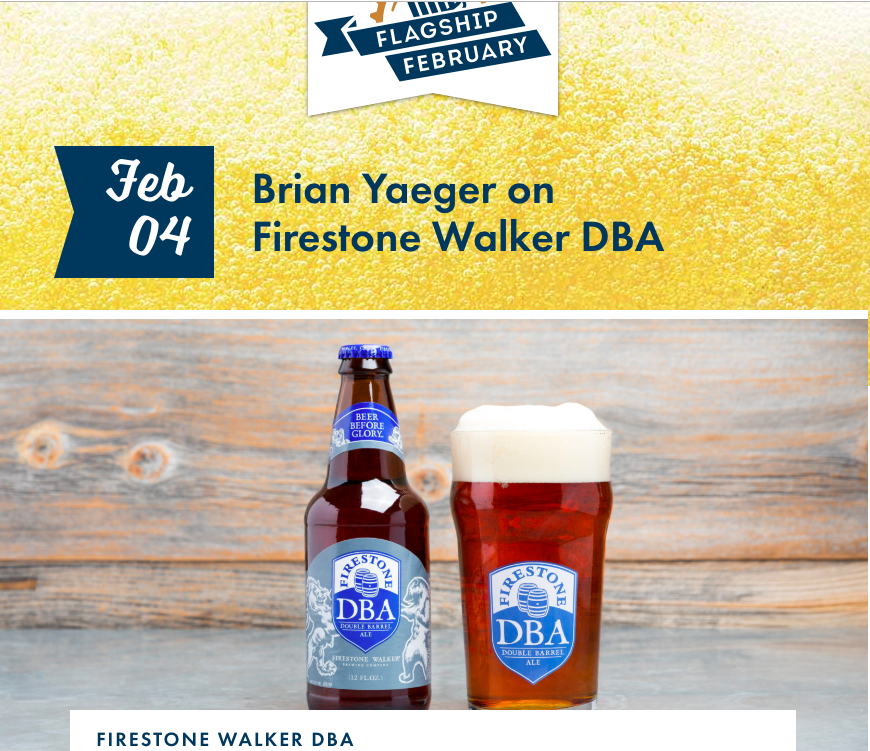
My pick for #FlagshipFebruary? My local DBA

I was honored to be invited to write an essay for the inaugural #FlagshipFebruary campaign.  In my essay about Firestone Walker DBAclick here–I open with a quote on craftsmen and craftsmanship by legendary designer Charles Eames. But here’s his quote that served as a bookend.

In 1957 Eames declared that the title of craftsman “places a tremendous responsibility on those who claim it.” He then referenced a fellow architect named Mies van der Rohe who Eames claimed once said, “I don’t want to be interesting. I just want to be good.”

Those are fitting words for DBA’s epitaph, yet DBA will never die. Not DBA’s somewhat fierce, perhaps nostalgic, decidedly local fans (myself included) have anything to say about it.

How a Beer Writer Writes About Wine

As the great American philosopher Fred Eckhardt declared, “Listen to your beer.” And since beer speaks to people, at least those smart enough to listen and thoughtful enough to hear it, it speaks of hops growing on the bines, amber waves of barley blowing in the field, or yeast hitchhiking on the breeze.

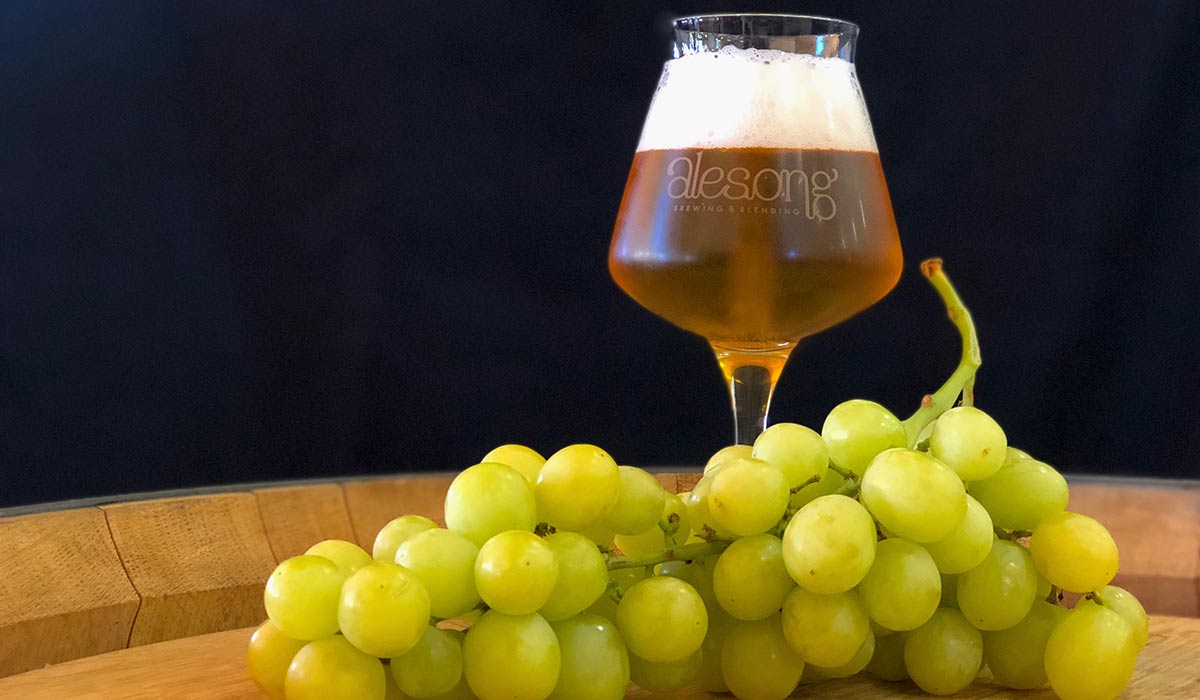
Brewmaster Matt Van Wyk’s beer obviously sings to him. He, along with brothers Brian and Doug Coombs, are the composers behind Alesong Brewing and Blending in Eugene, Oregon. And while they create a wide range of barrel-matured beers from earthy saisons to viscous imperial stouts, no doubt it’s the emphasis on vinous, wild ales that is music to sour beer lovers’ ears. But if their newest GABF medals are any indication, they could almost rename the brewery WineAlesong. And there are others singing similar tunes. For this reason, I got to write about those brewing at the intersection of wine and beer for CraftBeer.com.

I Kinda Have a Thing for Coffee Beers

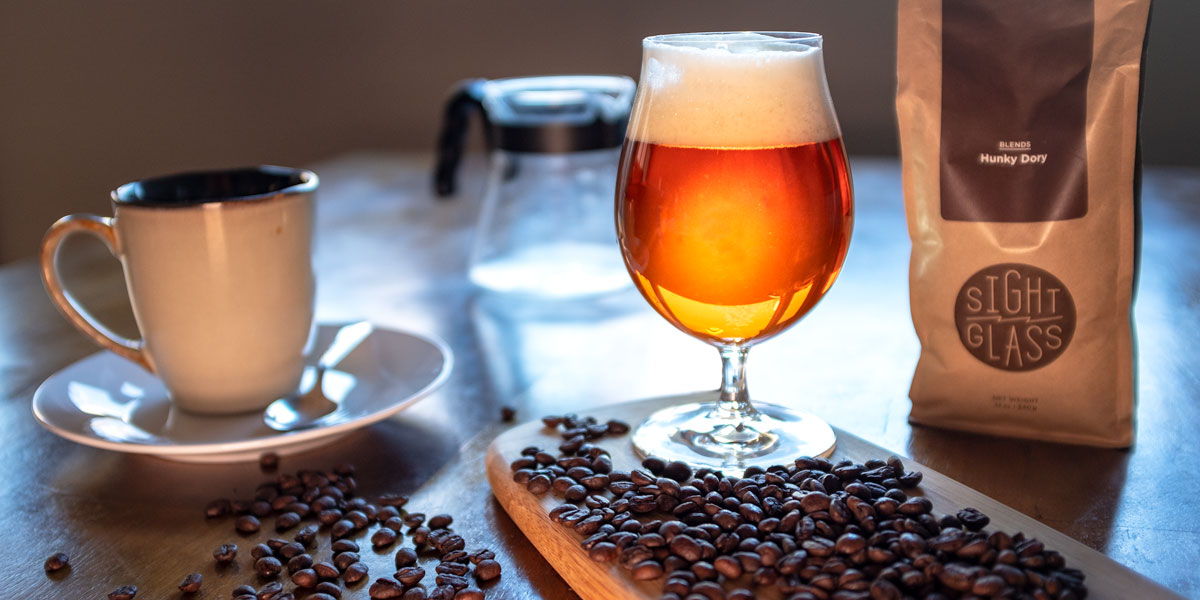
Naturally, the guy (me) who puts on a coffee beer festival (Baker’s Dozen) is into putting coffee in beer. And the style(s) that make the most sense is/are stouts and porters because of their innate coffee-ness. But we’ve come a long way, baby. For over a decade, ever since the Brewers Association introduced what was then called the “Coffee Flavored Beer” category at the 2002 Great American Beer Festival, the winners have been exclusively stouts or porters infused with coffee. It wasn’t until 2014 that Milwaukee’s MobCraft Beer broke the streak with a beer I’m not sure I’m allowed to name on CraftBeer.com where I wrote this story…but its “PG-name” would be “Guano” Crazy built on a brown ale base. Suffice it to say, I’m guano-crazy about coffee beers.

Bayou Berry Beers

Strawberry_HeroThe last story I’d written for CraftBeer.com narrowly focused on beers made with sage. So to zoom in even deeper, I didn’t just write about beers made with strawberries (not a broad category) but zoomed in on strawberry beers made in Louisiana, where they take their strawberry beers very seriously.  In fact, the North American Strawberry Growers Association represents commercial farmers in 40 states, but none of them seem to take up the mantle of celebrating this crop in their craft beers more than the Pelican State. Yeah you right

I’m a beer sage

epicsageI love herbal beers but I particularly think sage works wonders in the right beer. But good luck pitching a story about the so-narrow-it’s-nearly-two-dimensional field of sage beers. Unless there’s a hook, a peg, an angle. Hence, I waited months until I figured CraftBeer.com would want something on Thanksgiving beers, especially ones to suggest that aren’t flavored like pumpkin pie! And since a good stuffing mix and turkey brine includes sage, well, here’s a round-up of beers so sagey, they’re sagacious.

Beer review: 10 Barrel’s Riding Solo

10BarrelRidingSoloAmong my myriad New Year’s Resolutions for 2016 is to do more beer reviews. Between the samples I happily receive on my doorstep, beer travels that find me at different breweries across strange, new lands and just happening upon a new offering at some local watering hole, I want to ensure I’m paying good attention to what I’m drinking.

Seeing as a delivery guy just dropped off a bottle at 6:30 on a Saturday night, clearly it’s time to begin drinking. The beer is from 10 Barrel in Bend (not the 10 Barrel pub in Boise or Portland or the recently-announced forthcoming one in Denver). It’s called Riding Solo and it is, as the name suggests, a single-hop pale ale. Comet hops to be precise. Not that you’d possibly know that from the label copy. It reads: “We could talk about this single hop, but we’d rather talk about Benny, the brewer behind this pale ale. 4 years ago Benny was on the fast track working for a large brewery, and then it all came crashing down. He made a bad choice, climbed the wrong building in Bend and found himself in the clink without a job. We hired him the next day and he has been crushing it ever since. One brewery’s loss is another brewery’s gain. Cheers to the man behind the beer.”

Man is that a strange way to market a beer that theoretically has some educational aspect to it. It shows drinkers the aromatic and flavor profile of the nearly extinct Comet hop, a USDA varietal that I’ve personally never encountered. And anyone who buys this beer won’t know that they’ve had it. (Unless they are compulsive about every beer they try or read my oft-neglected blog religiously.)

Upon cracking the crown I was met with an herbal whiff and I’m only half referring to reefer. At first sip, I was struck by the spicy, dank bitter beer—like a skunk smoked a spliff cut with black pepper and dried grapefruit peel. It falls into the garlic’n’onion descriptor, too. Although they call it a pale ale, it’s orange in color and at 6.8% ABV and 67 IBUs it presents itself like an India Red Ale in malt and hop character. In fact, the spiciness makes it taste like there’s some rye malt in the grain bill, but doubt there actually is because then they’d probably have called it Ryeding Solo.