The Session #126: Hazy, Cloudy, Juice IPAs

sessionWhen I first started beer blogging, I was an avid Sessioner. Alack, I’ve been remiss of late and see that I participated once a year since 2013. That ends now. I’m recommitting myself (even if a few days late). And happily that means jumping back in as my friends Gail Williams and Steve Shapiro up at Beer By BART ask us to sniff on this:

(The) still-emerging – though no longer new – unofficial beer style. This kind of beer has gotten so much buzz (and some mocking) in the last decade and a half that it’s surprising it has not come up on The Session yet.  New England, Vermont-inspired, Northeastern, Hazy, Juicy or whatever you like to call these low-bitterness, hop flavorful beers, they are being made everywhere now and people are definitely buying them. So fire up your keyboard – let’s hear about your own encounters with these strange IPAs.

I like beer, all kinds of it in fact. And I certainly care more about the end result—its overall pleasantness as a factor of aroma, texture, and flavor—than I do about what style the brewer calls it or if it’s the “right” beer to be drinking either in terms of popularity or seasonal appropriateness. As such, when half the beer lovers I know are enamored of New England IPAs and the other half abhor the idea of opaque IPAs, I guess I’m firmly in the camp of take it or leave it.

I do faintly recall my first Heady Topper. It garnered a live-action Meh emoji. At the time, living in close proximity to Russian River and ergo fresh Pliny the Elder, I just figured the can I’d been handed (unsure how long it had been in transit) was the East Coast’s best stab at a bold IPA. It didn’t pop the way PtE does. Maybe I’d have dubbed it Pliny the Middle-aged. By the time I had it a second time, I was actually in the state of Vermont where the can at the Burlington airport failed to meet the tastiness of even the other Vermont-style IPAs I’d naturally sampled at breweries like Prohibition Pig (established in the same space where the Alchemist Pub suffered its fateful flood), FOAM, and one a bit less off the hype-grid, 14th Star Brewing up in St. Alban (where Verizon charged me as if I was in Quebec because it’s so close to the border). Their B-72 Double IPA, I got the sense, was brewed begrudgingly for tourists clamoring for this marketing terroir, but it really was hazy/juicy/smooth and I’d happily drink it again if I’m in Vermont. Because when in Rome.

There are signs NEIPA is in full-fledged fad mode, and it’s fast-tracking all the fads IPA itself has gone through. We’ve seen NEB(lack)IPA (or as I’d prefer to call it: a New England Cascadian Dark Ale—a hilarious oxymoron given that it’s both New England and Pacific Northwest in origin and would probably be brewed out of the Midwest). Oh, and we’ve seen the Citrus-infused NECDA!


IMG_5940

An afternoon visit to M Special Brewing in Goleta, CA. What’s in that snifter above?

Oh, and speaking of NEIPAs from Cascadia, back in Portland—which I already miss greatly—the first brewery to jump on the Vermont wagon was Great Notion Brewing. Their Juice Box (8.2%) and Juice, Jr. (6%) set the tone for PDX’s race to out-NE everyone, wherein even early poo-pooers are now hazing to the max. Among Great Notion’s litany of beers with the word “Ripe” in the name and “New England” in the description, there was one called Orange Creamsicle IPA. I’d never had Tree House’s infamous Julius—nor have I had it yet—but my first sip of Orange Creamsicle, made with both orange and vanilla flavors—instantly brought me back to my childhood spent at Orange Julius. And I think that’s why some adult beer drinkers slag these adult-beverages that sorta-somehwat appeal to more juvenile palates. They are fruity and juicy and sweet and, well, nostalgic. But hey, it’s not like the industry doesn’t have its share of famous beers that famously taste like Mexican chocolate cake or Reese’s Peanut Butter Cups or Cinnamon Toast Crunch, so there’s no reason to get sanctimonious about what other people enjoy in their glass of beer.


All kidding or ribbing aside, I just enjoyed a few beers at one of my new local breweries, M Special in Goleta, where I got a beer they honestly dubbed an NEIPL. And you all remember how much you scoffed the first time you saw the IPL acronym. Back to my original point, I only care if the beer I’m drinking is good, not if it’s a good style. And it had all the attributes those five letters denote: it was certainly citrus and tropical fruit forward, more sweet/less bitter, and some of the clean, crisp expression of lagering over top/warm fermenting you’d look for in a lager and before you get all bunched up that lagers are ultra clear, then you need to have a kellerbier my friend. I think even some progressive German brewers could clearly see their way to appreciating an NEIPL or NEIPA, even if they can’t see through it clearly.
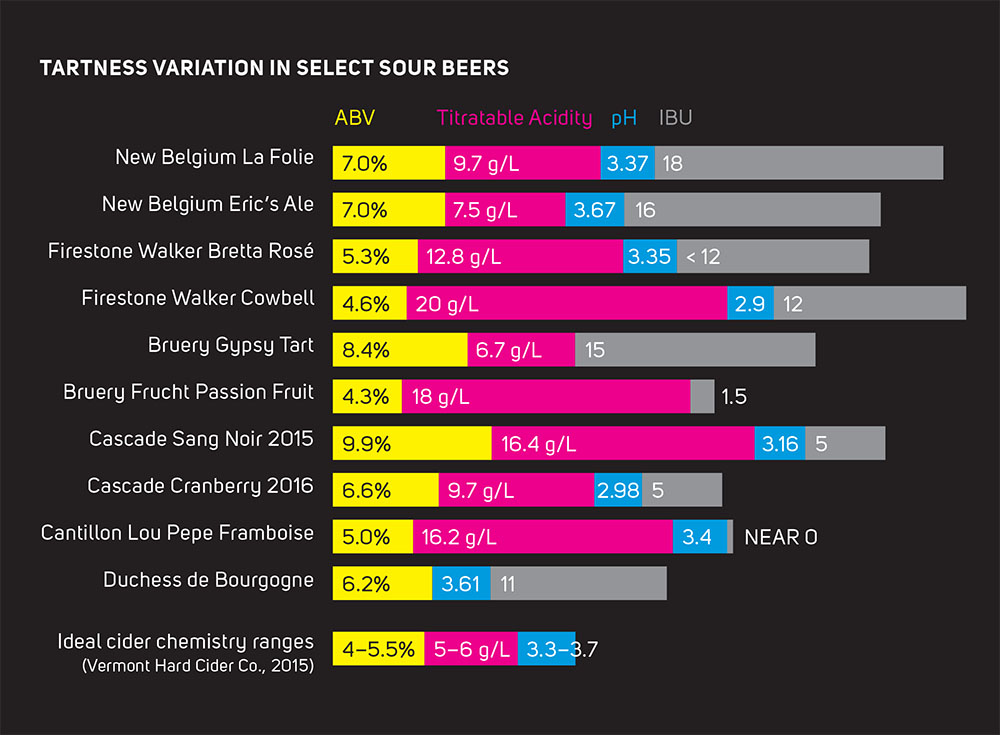
Just how sour

Edit: This story was awarded 2nd place in the Technical Writing category at the 2017 North American Guild of Beer Writers (NAGBW) awards. While I’m extremely grateful to the judges, it’s humbling yet a li’l embarrassing that the estimable technical beer writer Randy Mosher placed 3rd for this cool story, “Hot Process: Exploring the role of heat in brewing” in All About Beer. Stan Heironymus took 1st place with his story on brewing with honey, also in AAB.

Remember Top Secret? Remember that great song in it, How Silly Can You Get? That’s how I think of a lot of beers. How alcoholic can you get? Brewmeister’s Snake Charmer has an ABV of 67.5% How bitter can you get? Flying Monkey’s Alpha-fornication packs 2,500 IBU. From OG/FG to SRM, brewers have a lot of measurements and acronyms to tell the consumer just how something something is. For sour heads, ours may come in the form of TA. Titratable Acidity. Firestone Walker Brewing isn’t the first to use TA in their lab, but they are the first to put how quantifiably sour their beer is right on the label of their funky Barrelworks offerings.

Now, a quick word about this story on Titratable Acidity just published in the November issue of BeerAdvocate: it’s crazy heavy on the chemistry-spiel, and I barely passed high school chemistry. I do this from time to time–I really challenge myself to wrap my head around a story. I had never heard the word “titratable” or “titration/titrating” before pitching this. I bludgeoned these poor master brewers, master blenders, and folks with Ph.D.s in food and brewing science with questions first so I could begin to understand what’s going on with the acidity in certain beers–specifically what types of acids are present and how they got there–and once I felt semi-comfortable with that, I had to write it up for the readers who didn’t have the same access I got. SO… if you think this story is “TL;DR” just imagine poor little me for whom it was nearly TL;DW. (And here I massively applaud my editor at BA, Ben Keene, for whom this must’ve been challenging to no end but did a masterful job, even if he originally assigned me 1,800 words, then caved and gave me 2,000, and somehow got it way, way down to 2,300!)

Draft: Craft Lightens Up

Funny where inspiration will hit. For me, it was at a G. Love concert at a music venue that serves beer from such dirty tap lines I’d vowed never to drink there again. Until I made a valuable discovery. Actually, it was a $2 discovery.

For an industry defined by its antithesis to cheap, macro light lagers, does its growth hinge on emulating that model?

Is Pale Passé?

From BeerAdvocate #114:

In 1983, Sierra Nevada Pale Ale medaled at the Great American Beer Festival. Not in the Pale Ale category, mind you, but it was one of three beers singled out for honors in the Consumer Preference Poll. At the time, the beer was just three years old. Today, 33 years later, the brand remains the tippy-top selling craft brewed beer in America. Brian Grossman, 31, is Sierra Nevada co-founder Ken Grossman’s son and manages the company’s second brewing facility in Mills River, N.C. He proclaims that he absolutely drinks this beer every week. “[Pale Ales are] the Swiss army knives of beers,” he says. “They’re about 5 percent [alcohol], mid-30s IBU, have nice hoppiness, go great with a wide variety of foods, and are sessionable.”

According to Chicago-based market researcher firm IRI, Sierra Nevada Pale Ale is a $130 million juggernaut, but “Pale” has diversified and split off in hoppier, bolder directions. It has evolved past its original, caramel malt-driven British template. It has even morphed beyond the brasher, hop-centric American iterations. Name a brewery that opened between 1980 and the early 2000s though, and it most likely featured a Pale Ale prominently in its core line-up—even if that wasn’t the flagship brand.

And then India happened.

Barley, Hops, Water and…Yogurt?

Edit: This story was awarded 1st place in the “Short Form” category at the 2016 North American Guild of Beer Writers (NAGBW) awards.

From BeerAdvocate Magazine #103:

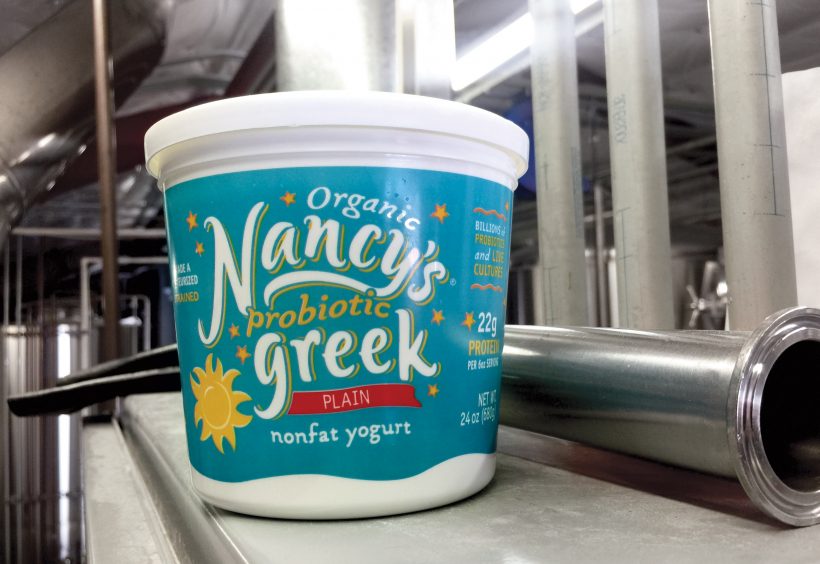
No one raises their eyebrows when black currants are used in a beer these days, but yogurt? To create the desired tartness and acidity in The Commons Brewery’s Biere Royale—a riff on the cassis-based Kir Royale cocktail—head brewer Sean Burke pitched tubs of the stuff. Specifically Nancy’s brand Greek yogurt. Burke is from Eugene, Ore., not far from the creamery’s location. Plus, it was in his fridge. Remarkably, the creation of that beer for the 2013 Portland Fruit Beer Festival is one the first uses of Lactobacillus found in unpasteurized yogurt to acidify beer. Instead of extensive aging in barrels inoculated with acid-producing bacteria, Burke went with a probiotic-rich dairy product.

“We knew we wanted to have a high amount of acidity,” said Burke at the time. “We took Nancy’s Greek yogurt and created a starter and soured in the kettle. Nancy’s has multiple strains of Lactobacillus… We mashed into the mash tun, lautered into the kettle, then soured the collected wort.”


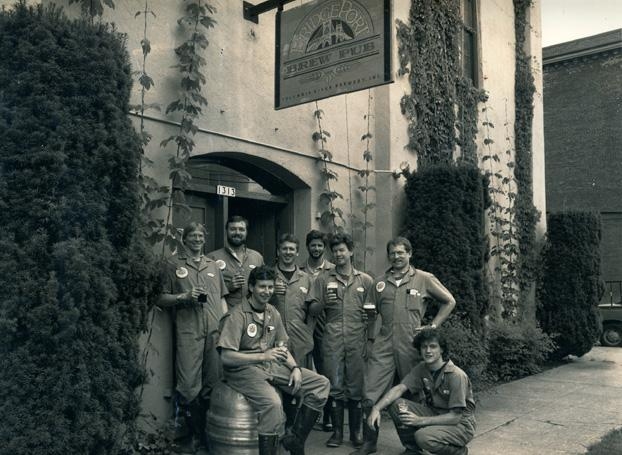
An Oral History of BridgePort India Pale Ale

This is the second installment of this type of oral history of a Portland beer that would go onto help shape not only the Portland beer scene, but impact the national beer climate as well. Crazy to think that before this beer debuted in 1996, most beer drinkers in America had no clue what an India Pale Ale was.

Image courtesy BridgePort

Image courtesy BridgePort

Willamette Week “Drank” reviews

Wherein I review the following new releases on shelves or on tap:

Flat Tail: Cider Wit (Jan. ’12)

Philadelphia’s: Barrel-aged Betsy Ross Golden Ale (Feb. ’12)

Everybody’s Brewing: Little Sister ISA (Mar. ’12)

Lompoc: Batch 69 Baltic Porter (Apr. ’12)

Fort George: Roses on Roses (May ’12)

Hopworks Urban Brewery: Abbey Ale (June ’12)

Double Mountain: Devil’s Kriek (July ’12)

Base Camp: In Tents IPL (Nov. ’12)

Salmon Creek: Märzen (Dec. ’12)

Caldera: Mogli Bourbon-oaked Imp. Chocolate Porter (Jan. ’13)

Agrarian: Espelette chili beer (Apr. ’13)

Flat Tail: Lemon Diesel (Aug. ’13)

Lucky Labrador: Black Sheep bourbon-aged CDA (Sep. ’13)

Finally, well, most recently, this review of Rogue’s Brutal IPA…per the editor’s request to review it particularly as it tastes having traveled to Amsterdam. (Jan. ’14)

Rye Revolution

For nearly 500 years, Germans mandated that beer be made from only water, hops, and barley. More recently, however, Northwest brewers began embracing virtues of rye. This segment of Portland Monthly’s feature, “Wallet Guide,” explored five rye-fueled brews that embrace the flavor-packed grain.


India Session Ales

All the IBUs. Half the ABV. Welcome to the India session ale (ISA). This is the story for CraftBeer.com that inspired one of my most revered beer writer colleagues, Martyn Cornell from the UK, to posit, “India Session Ales – tremendous new trend or oxymoronic category fail?” What’s your favorite sessionable IPA? What’s your take on the debate over this style?