Unknown's avatar

About Brian Yaeger

Author of beer books "Red, White, & Brew" & "Oregon Breweries" and, soon, "American Doughnut."

Portraits of Dead Soldiers Left in the Yard: Bad Hombres Edition

Three and a half years ago, evidently, I was inspired to write a series of blog posts inspired by a particular type of infuriating litter I’m always finding in our flower boxes or somewhere near the front yard: dead soldiers. Empty beer bottles and cans. Click here to see the entire “series” (2 posts: BridgePort IPA and Sparks: Blackberry) from my old Beer Odyssey blog. I pick up so many recyclables–both craft and macro–that I’m occasionally inspired to kickstart it back up. But today’s discovery made it imperative.

Some of you know of one of my beery obsessions: nips. Fun fact: a story I wrote about tiny bottles appears as a reference on Wikipedia! And in fact, they were the subject of yet a different blog: Welovenips. That one I evidently pulled the plug on two years ago. It still lives on in Twitter form. (Follow @welovenips for a bimonthly tweet.) So imagine my delight and horror–equal parts–when I discovered these three amigos in said planters.

fullsizerender

This tears me apart. I love cuartitos or chicos, but Corona is my absolute least favorite Mexican lager.  I’m not sure if these bad hombres were smuggled over our open borders or were simply bought at Freddy’s across the street, but clearly someone was thirsty enough for 14 oz but not for 21. Oh, I confess I was tempted to crack open that third one and write a review of a lightstruck Coronita, but I was afraid Dia de los Muertos might arrive 11 days early.

These planters are for succulents. Not sucky beer.

Portland’s Beerly Walkable Buckman/Hosford-Abernethy

https://www.instagram.com/p/BKv_uU7D-0G/

The Brewers Association announced to their freelance crew that they would be adding a feature called “Walk this Way” for their Beer Muses blog (about walkable brewery ‘hoods). Natch, I pitched that it needed to start with Inner Southeast Portland’s twins Buckman and Hosford-Abernethy. Here’s the result, published August 30, 2016.And already

The kicker? Fewer than 7 weeks later, we’ve already seen Mt Tabor Brewing Company – PDX & Scout Beer open. (And possibly in the next 7 weeks we’ll welcome Wayfinder Beer & Ross Island Brewing.) That will bring us to 13 independent breweries within a 2.5 mile walk! CheersGrixsen Brewing Company, Baerlic Brewing Co., Ground Breaker Brewing,Lucky Labrador Brew Pub, PDX Green Dragon, Cascade Brewing, The Commons Brewery, Hair of the Dog Brewing Company, Base Camp Brewing Company, Burnside Brewing Co


Draft: Craft Lightens Up

Funny where inspiration will hit. For me, it was at a G. Love concert at a music venue that serves beer from such dirty tap lines I’d vowed never to drink there again. Until I made a valuable discovery. Actually, it was a $2 discovery.

For an industry defined by its antithesis to cheap, macro light lagers, does its growth hinge on emulating that model?

Lush Life: Tiny Wolf and Portland’s Nanos

I’m forever deliberating over the impact nanobreweries can or do have on a city’s beer culture. For every Commons (nee Beetje) brewery in Portland or Hess in San Diego, there are seemingly a dozen more that think they can emulate that level of success. To find out what these nanobrewers want to get out of the brewing industry, and what they think can have to contribute, I went straight to the teensy-tiny sources in my August turn at the Mercury’s Lush Life column.

The Rural Brewer Spotlight: Siuslaw in Alsea

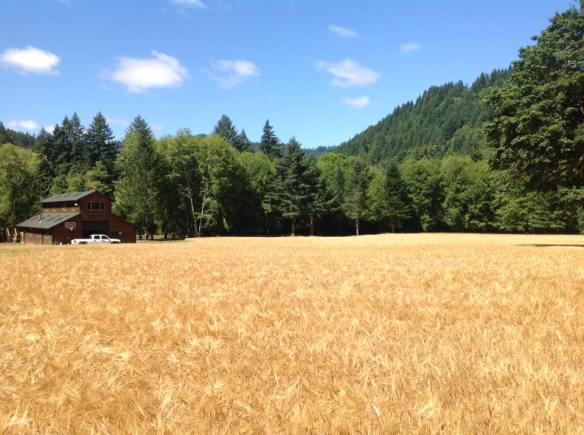
Alsea is the smallest town in all of Oregon with a brewery. Give or take, 164 people call it home. When I wrote the Oregon Breweries guidebook, I made it to each and every brewery in operation across the state. Several have opened since it was published and it burns me that I haven’t made it to all of those, as well, but, let’s face it, for city folk like me in Portland, it’s not often I find myself in Alsea. Truth of the matter is, I’d never heard of Alsea (named for the Alsea River and/or the Alsea tribe of Native Americans) until Siuslaw BrewingSiuslaw field (named, presumably, for the Siuslaw National Forest that occupies a tiny part of Alsea’s Benton County) put it on my map.
The 2nd The Rural Brewer Fest will be my first time trying their beer. It sounds pretty bad-ass since, get this, Duane and Jesse (the brewer) Miller grow their own hops. OK, a few other breweries do that, too. But they also grow some of their own barley and malt it themselves.

The farmhouse brewery—or rather, forest-house brewery—in Alsea is located in Benton County about halfway between I-5 and the coast 30 miles southwest of Corvallis. As such, its nearest breweries are ones like Block 15 and Flat Tail, but keep going and then the next closest ones are 45 miles farther including Yachats Brewing and Wolf Tree Brewing. Yeah, those are so rural they’re also featured at The Rural Brewer fest (as returnees!)

Wanna see it for yourself? As Miller said via FB DM, “We have a beautiful piece of property on the Alsea River and welcome all who want to stop by and see what we are doing. We brew many styles and continue to perfect our recipes. Hopefully we will meet up sometime!”

Those styles include an IPA and a Double Black IPA. A Blonde Belgian and a Strawberry Rhubarb Ale. There’s a wide range but as for what they’re bringing up to Portland, Grass Clippings is a cream ale brewed with barley grown on the farm (and again, malted there too), using a method that retains the fresh barley flavor.


The Rural Brewer Fest Spotlight: Chetco

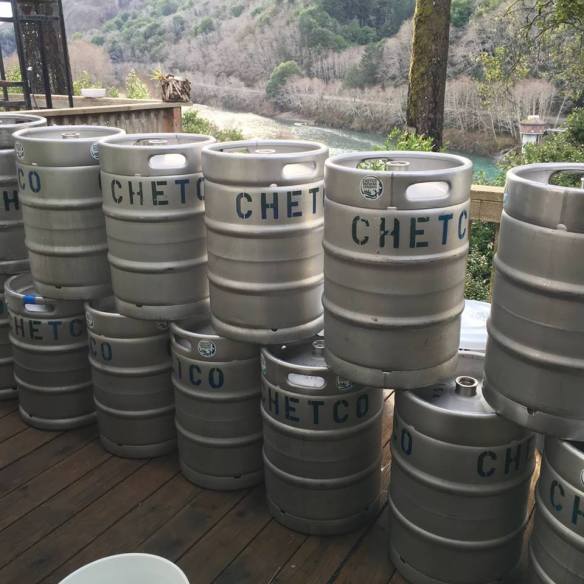
Chetco photo

Photo: Chetco Brewing’s Facebook page.

Interested in attending the 2nd The Rural Brewer Fest on Sat., July 23 at the Hawthorne Hophouse? Get your tickets here.

Down in Brookings, named for a man named John Brookings, some 6,374 people reside in the picturesque coastal hamlet. That’s about 1% of Portland’s population. But whereas Portland has roughly one brewery for every 10,000 residents, Brookings–home to Chetco as well as Tight Lines and Misty Mountain breweries–boasts a 1:2,100 ratio. Clearly those who’ve followed in John Brookings’ footsteps love local beer. And while the first two aforementioned breweries didn’t even open until 2013, Chetco didn’t take long in establishing itself as a world class brewery by winning a silver medal for Block & Tackle Stout at the 2014 World Beer Cup.

While that onyx ale achieves a unique viscosity after aging for six months, and the resulting notes of baker’s chocolate achieve the right balance between a sweet and dry stout, it hardly seems like a fitting sample to enjoy at a summertime beer festival. Instead, brewer Mike Frederick, who co-founded the brewery with his wife Alex, will be pouring The Chetco Effect. This summer ale is a light, bright ale dry hopped with Sorachi Ace to give it a crisp lemon finish. It’s named for a weather phenom in Brookings (that you can read about here but they lost me at “adiabatic” in the first sentence.)

Mike loves brewing single-hopped IPAs and beers in general. “I just think it’s a fun thing,” he said to me over an IPA. “You get those particular characteristics.” One characteristic of some of Chetco’s beers that no other brewery has is that they boast his homegrown hops. The Fredericks have some 80 bines in their backyard, eleven varietals strong. Within three weeks of his first home brewed batch from the kit his wife, Alex, gave him, not only did he graduate to all-grain brewing but, said Mike, “I had ordered hop rhizomes so I could grow my own.” The brewery’s rooted in their DIY ethos having self-financed. Even the system comes with a good story, a nano-story that Mike sports on the back of his T-shirt. “A good friend lends you his awesome home brewing system. A great friend lets you open your microbrewery with it.” The friend in this tale is James Smith from Arch Rock Brewing up Highway 101, which, incidentally, has some gold medals under/over its belt so if anything The Rural Brewer Fest proves it’s that a beer trip to Oregon’s South Coast is in order!

The Rural Brewer spotlight: Boring

cropped-john_final_short_two

Interested in attending the 2nd The Rural Brewer Fest on Sat., July 23 at the Hawthorne Hophouse? Get your tickets here.

Some city folk think rural towns are boring. But this place that’s more of a suburb of Portland—15 miles east sandwiched between Gresham and Sandy—is truly Boring. And it’s where John Griffith’s road to becoming a nanobrewer began in back 1989 when he grew obsessed–his word choice–with homebrewing, thanks to the likes of Charlie Papazian.

Griffith has never stopped championing the DIY approach to better beer. After years of dreaming about starting his own brewery, a little fate and a lot of paperwork allowed Griffith to brew commercially in an accessory building on his own property. Visitors used to have to look for the little sign he sets up out front on the sleepy street and then were greeting not by stainless steel equipment but his goats and chickens, who are happy beneficiaries of his spent grains. He launched Boring Brewing with a 5-barrel brewhouse in 2013 and earlier this year, March of 2016, he opened a Taproom (located at the corner of Hwy 212 and Richey Road next to the Boring Station Trailhead; you can get three crowlers for twenty bucks if he puts them on special.) Last year, Griffith produced just over 100 barrels.

Here seems like a fine time to interject: the city’s named after William H. Boring, a Union Army veteran who moved here after the Civil War. The town adopted its name in 1903. Also fun to note: Boring (population 8,000) is the sister city to Dull in Scotland.

As a radiology administrator, Griffith has worked in health care since 1983 and took up homebrewing in ’88. He did take also a weekend course in brewing science at University of California, Davis. In 1993 his porter took first place at the state fair.

The first Boring beer, RyPA, which he’d been honing since it was still the 20th century, went into fermentation tanks in late 2012 and debuted in early 2013. Hoppy Blonde, a true light-bodied blond with just enough of a floral kick to keep it from being, hm, uh . . . banal, has become his bestseller thanks to having more permanent tap handles than the others. Riffing off the name, Griffith introduced Big Yawn IPA as an even hoppier option. “I got feedback on the RyPA,” he said with an implied scratch of his head. “It didn’t have a big enough hop character for the Portland crowd.” For the sake of comparison, Big Yawn makes folks open wide for its 7.5 percent ABV backed with 75 IBUs. This, my friends, is the beer you’ll get to sample again at this year’s The Rural Brewer Fest.

Is Pale Passé?

From BeerAdvocate #114:

In 1983, Sierra Nevada Pale Ale medaled at the Great American Beer Festival. Not in the Pale Ale category, mind you, but it was one of three beers singled out for honors in the Consumer Preference Poll. At the time, the beer was just three years old. Today, 33 years later, the brand remains the tippy-top selling craft brewed beer in America. Brian Grossman, 31, is Sierra Nevada co-founder Ken Grossman’s son and manages the company’s second brewing facility in Mills River, N.C. He proclaims that he absolutely drinks this beer every week. “[Pale Ales are] the Swiss army knives of beers,” he says. “They’re about 5 percent [alcohol], mid-30s IBU, have nice hoppiness, go great with a wide variety of foods, and are sessionable.”

According to Chicago-based market researcher firm IRI, Sierra Nevada Pale Ale is a $130 million juggernaut, but “Pale” has diversified and split off in hoppier, bolder directions. It has evolved past its original, caramel malt-driven British template. It has even morphed beyond the brasher, hop-centric American iterations. Name a brewery that opened between 1980 and the early 2000s though, and it most likely featured a Pale Ale prominently in its core line-up—even if that wasn’t the flagship brand.

And then India happened.

German Reinheitsgebot’s Living, Tasty History

Drinking a maß of Märzen or sipping a stange of Kölsch is okay as far as trying to celebrate the Reinheitsgebot and Germany’s 500-year-old beer purity law, but when I was invited to head to the land of lagers and weisses to see how this tradition is holding up, I found two things: braumeisters who are, admittedly, a bit jealous of the creativity that modern craft (or privatebraueries) allow, but also people who take great pride in making the beers that their customers love and feel very passion about as being real bier! Southern Germany is postcard picture beautiful at nearly every turn. Prost!

Firestone Walker Invitational Bassoon Festival

IMG_0028

Adam Firestone, 2005. Photo: Yours truly

Today, I’m heading down to Paso Robles, California for the 5th Annual Firestone Walker Invitational Beer Festival where more than 50 breweries (and thousands of beer nerds) across California, the country, and indeed the world will gather once again to become engrossed in beer (and beer culture). Yesterday, while listening to my iTunes on random-play as I worked, rather than a song a spoken word track started to play. My own voice. I was dictating notes to myself about afterthoughts from my 2005 interview with Adam Firestone.

I wasn’t a beer writer then. I was an aspiring one. I wasn’t drinking much in the way of bourbon-aged strong ales back then. But that’s OK because Firestone Walker wasn’t making them yet. Part of my notes-to-self was about the impending release of “Firestone Ten.” XX will be released later this year. So bear in mind—Firestone pun intended—that they brewery was working solidly in the pale ale realm still. No wild ales like SLOambic. No Wookey Jack Black Rye IPA. Not even Union Jack. That’s right. They hadn’t even unleashed their now-flagship IPA brand. Today, they’re still all about their Burton Union, er, Firestone Union method of fermentation that’s prime for making British-style pale ales that co-founder and Adam’s brother-in-law David Walker still prefers. (In a phone interview with David this past April he said of Double Barrel Ale, a British Pale, “I drink DBA every opportunity I can. It’s my favorite style.”)

As I sat there listening to the track, it was telling that Adam, when talking about not aging but fermenting beer in wood, told me that any brewer worth his salt would know better than to do that. Or at least challenge that, which is what Matt Brynildson did when he joined the brewery. Tangent: I’d also interviewed Matt in October of 2005. He discussed having brewed for SLO Brewing where he didn’t like having to make their Blueberry Ale not because it was fruity but because it wasn’t made with real fruit, just flavor additive. I attended UC Santa Barbara nearby—graduating months before Firestone Walker launched—and recall drinking and, dare I say, enjoying said Blueberry Ale (as a 21-year-old whose friends only drank beer that came in $35 kegs or 36-can suitcases). Matt also said back then that Oak is a flavor so it’s really beer’s “fifth ingredient.”

Back to the track. Adam likened their method of brewing to “being in the bassoon business.” I’m paraphrasing: “Not everyone plays bassoon, but if that’s what you do, and it’s a wonderful instrument, you really gotta throw yourself into making a good bassoon.” I loved that analogy. (And lemme tell you something. Those double-reeded woodwinds can run up to 30 grand, but you’re not getting out for under five thou because you’re not some podunk oboe player amirite?) What Adam meant—and the sentiment was echoed during my in-person interviews with David and Matt, too—is that Firestone Walker doesn’t make beer for everyone. Anyone can play the kazoo. They make the bassoons of beer. Elegant. Rich. Unique.

According to my dictated notes, Adam went onto say, “You don’t have to be all things to all people.” He divulged that, despite it being the era where Hefeweizens and Witbiers were the big deal in microbrewing (imagine if brewers today were trying to out-wheat each other or tout being the first to use an experimental varietal of grain), he was no fan of wheat. Nor of hemp seeds, which, if you know their history with Humboldt Brewing and Red Nectar Ales, is pretty funny. First met Adam behind the table while pouring at the 2005 GABF.

Beside the bassoon line, I had a compulsory discussion with Adam about his kid brother, Andrew, who’d been the star of an early season of The Bachelor. Yikes! But Adam had a really interesting take. “Just like the 70’s had 8-tracks and the 50’s had hula hoops, we have reality TV shows and those won’t be around in future generations, either. Like TV, previous generations were concerned with who shot J.R.? This generation is concerned with who’s the bachelor going to pick?” He added that the show brought great marketing might to the Firestone Winery. Less to the Firestone Walker Brewery. He also used the word fungible two or three times. Yeah, he dropped it during the course of conversation. I hardly read or hear that word, but when I do, I can’t help but think of Adam.

So that’s it. It’s crazy to think about what has transpired in the decade since, with me, with the beer industry and scene in general, and with this brewery in particular. Firestone Walker has amassed 47 GABF medals since 2002 and hasn’t had a single dry year. David really does all the publicity and public engagements. He’s simply very affable and charming. Of course he is; he’s British. But as Adam copped to me back in 2005, the two of them got along well, which Adam said is a testament to David’s character since he’s aware that he himself is not the easiest person to get along with. “Strong opinions.” So when his brother-in-law began prattling off about starting a “microbrewery,” Adam fortuitously said, “Yep, let’s do this.”

Below is the excerpt from Red, White, & Brew about Firestone Walking Brewing. At the time, they were the one brewery I intended to make a full chapter in the book but did not. The goal was to get the deep, inside story not of every brewery in America, but 1%. That’s why there are 14 chapters in the book. There were 1,400 breweries. I didn’t think there’d be 1,500 by the time the book came out, which, in 2008 had actually climbed to 1,574. If I were to write Red, White, & Brew today using that same approach, I’d have to write 44 chapters! Anyway, it’s not my best writing, but it was my humble start. Check out the part where we learn before Firestone made sessionable pale ales, a Firestone made non-alcoholic beer (from 1986-1990)! And as a bonus, I’ll start with a line not pertaining to Firestone Walker but that leg of my roadtrip around America’s breweries:

…In the Palm Desert it is the Sonny Bono Memorial Highway, in memoriam to the former mayor of Palm Springs who couldn’t ski the forest for the trees…

Months after I graduated from the University of California at Santa Barbara in 1996, a new brewery opened up nearby. It belonged to two brothers-in-law, Adam Firestone and David Walker, hence the name Firestone Walker Brewing. The Firestone name, of course, is well known, as tire magnate Harvey S. Firestone was a rubber baron. Harvey’s grandson, Brooks, used his inheritance to start the first estate winery in Central California. In turn, his son, Adam, while already president of the Firestone Vineyard, partnered with David. They have Adam’s sister, and David’s wife, Polly Firestone-Walker, to thank for bringing them together.

I didn’t discover Firestone Walker beer until I went to Denver. At the GABF’s Pacific Region section of the festival, I met Adam, tall and youthful, pouring his beers from behind his table. He told me about his dad’s side venture making, of all things, non-alcoholic beer in the late eighties. While serving as a Marine overseas, Adam pleaded with his dad not to fold the operation. But when brands like Miller Sharps and Coors Cutter were introduced, Brooks pulled the plug.

Soon thereafter, Adam returned, having done a tour in the first Persian Gulf War. After taking over Firestone Estates, he lit out on a scavenger hunt to track down old brewing equipment for his side project. Because it proved to be a success, now he’s got shiny new equipment. If only his kid brother Andrew had revealed as much about the brewery in “The Bachelor” reality series as he did about the winery and his own personal dalliances, the brand might have a broader reputation.

The vineyard, the brewery, and a new brewpub are spread across the Santa Ynez Valley along the Central California coast, 90 miles apart. The latter, the Taproom, is in Buellton, most famous for its split-pea soup—I kid you not. The pub is located near the tree that Thomas Haden Church crashed Paul Giamatti’s Saab into in the movie Sideways. Instead of chasing down wine, my destination was beer. Looping around the off ramp that circles the tree, I made my way off the 101 and into the Taproom.

I met David, a tall British bloke gracious enough to plunk down in a booth with me and discuss their initial, and failed, idea to make beer in the winery’s spent Chardonnay barrels. Instead, the brewery patented a method of fermenting beer in charred oak barrels. Aging beer in barrels isn’t that uncommon, but these guys are the only ones in America who use them in the fermentation process. Every brewery that uses stainless steel thinks these guys are crazy. But after you taste their Double-Barrel Ale, you’ll be a convert, too.

David slipped behind the bar and pulled me a few tastes including an unfiltered version of Double Barrel. I’m not much for discussing noses, legs, or bouquets, but this beer boasted some serious oakiness. My hat’s off to brewmaster Matt Brynildson, who earned Mid-Size Brewer of the Year honors at last year’s GABF.