I WAS RIGHT (5,005 Breweries)

Ask my long-suffering wife. By that token, ask any of my ex girlfriends. Ask my parents. Ask any of my friends over the last 30 years. Ask any of my ex friends if the reason they’re no longer my friends is because they think I always have to be right. But the takeaway here is: I was right.

Back when Derrick Peterman of Ramblings of a Beer Runner hosted the 67th monthly installment of The Session, a beer blogging exercise. In short, he wanted to know how many American breweries there’d be in five years. At the time (2012), the Brewers Assocation (BA) stated there were 2,126 in operation. To start off his round-up, Derrick said, “As for who wins the prize, forgive the sappy cliché but you’re all winners.” But he, unlike me, was wrong. Oh sure, David Blascombe of Good Morning… was also right in a slightly more general sense. He was more not-wrong than I was right (on the money). He put down “Over 5,000.” I predicted 5,001. Seriously, click on that.

In my blog, I reasoned that, “it’d be logical that since more Americans prefer beer to wine, there should be more breweries. Or at least the same amount. Fine, how about at least HALF as many!?”

This morning, the BA announced that on November 30, 2016, the United States reached a new peak in the brewery population: 5,005. They further pointed out that it is half the number of wineries.

screen-shot-2016-12-05-at-12-00-24-pm

Bart Watson, Ph.D. is the BA’s Chief Economist. Dude’s got mad numbers skills. And I pinged him this past summer, when I noticed that the official count had topped 4,500, if he thought my prognostication was correct in pegging the year-end tally at five grand. “We’re averaging closer to two a day (net) over the past 12 months rolling,” Watson said, regarding the rate at which breweries open. “Based on what I see – I think end of the year is about when I’d predict 5,000, though could be a bit longer if closings finally start to tick up.” For all the media speculation about the craft beer bubble bursting, and some dire reports painting a slow-down, I’m going on record as saying: nuh uh. Don’t buy it. Well, the “craft” segment as a whole may continue to grow at a snail’s pace, but grow it will. More specifically, the number of breweries will continue to climb even if that means that the largest producers—or perhaps just the mid-range ones—will see stagnant sales. To bolster this assessment, Watson added, “There were 6,080 active Federal licenses at the end of 2015, so it’s just a matter of when all those breweries in planning open their doors.”

Here in Portland, we have 65 commercially operating breweries. That’s a number that all but about five other cities would be screaming “Saturation Point.” And yet we just welcomed three new ones in a third-mile radius. And three more are on track to open this winter. There’s absolutely reason that every American city with our population or larger can’t sustain as many breweries. That’s 25 larger cities by population. Some 640,000 people call Portland home. Denver has about 690,000 and, congratulations Mile High City, you’ve passed Portland with your 73 breweries. San Diego (pop. 1,4M) claims 130, but that’s all of SD County. The 690,000 folks who live in Seattle proper have 59 breweries to call their own.

On the flip side, my most recent Beer Traveler column for All About Beer focuses on metropolises that are just turning into beer destinations, places like Fredericksburg, Virginia and Cedar Rapids, Iowa. Yeah Iowa! If you brew it, they will come!

Below are the rest of the predictions submitted back in 2012. Not that they are all below 5,000. Technically, Derrick asked for our predictions in exactly five years, so mid-2017, but I say we’ll have at least 5,400 next summer, unless people stop loving beer, or there’s an asteroid heading for the US, or Trump’s economy wreaks havoc on par with Prohibition + planetary annihilation.

Just for funsies, remember this number: 8,075*. Between the openings and inevitable closures, that’s my guess… How many breweries do you think will be operating in America in 2022?

*Edit from 2022: The BA announced there are 9,552 breweries in America. Missed it by “that” much.

————————————————————–

4,252 In their Session debut, The Brew Gentlemen

3,189 Alan McCormick of Growler Fills

3,125 is the number Jon Abernathy of the Brewsite predicts My good friend Jon… my poor, stupid friend Jon… predicted…

Around 3,000 opines Sean Inman of Beer Search Party

2,831 is the number Chris Staten of DRAFT Magazine

2,620 Stan Hieronymus of Appellation Beer Stan is obviously quite wiser than I. But…

2,589.5 is the prediction by What We’re Drinking, … his home town of Dayton, OH, he writes:   “I do think that 3-4 local, small scale breweries can be sustained within a city the size of Dayton…”…It’s worth noting the population of metro Dayton, OH is about 840,000. (Editor’s Note: there are currently FIVE in Dayton)

2,500 is the number by Roger Mueller of A Fool and His Beers

1 A dire prediction that one megabrewer will control the world comes from Jon Jefferson of 10th Day Brewing.

Portraits of Dead Soldiers Left in the Yard: Bad Hombres Edition

Three and a half years ago, evidently, I was inspired to write a series of blog posts inspired by a particular type of infuriating litter I’m always finding in our flower boxes or somewhere near the front yard: dead soldiers. Empty beer bottles and cans. Click here to see the entire “series” (2 posts: BridgePort IPA and Sparks: Blackberry) from my old Beer Odyssey blog. I pick up so many recyclables–both craft and macro–that I’m occasionally inspired to kickstart it back up. But today’s discovery made it imperative.

Some of you know of one of my beery obsessions: nips. Fun fact: a story I wrote about tiny bottles appears as a reference on Wikipedia! And in fact, they were the subject of yet a different blog: Welovenips. That one I evidently pulled the plug on two years ago. It still lives on in Twitter form. (Follow @welovenips for a bimonthly tweet.) So imagine my delight and horror–equal parts–when I discovered these three amigos in said planters.

fullsizerender

This tears me apart. I love cuartitos or chicos, but Corona is my absolute least favorite Mexican lager.  I’m not sure if these bad hombres were smuggled over our open borders or were simply bought at Freddy’s across the street, but clearly someone was thirsty enough for 14 oz but not for 21. Oh, I confess I was tempted to crack open that third one and write a review of a lightstruck Coronita, but I was afraid Dia de los Muertos might arrive 11 days early.

These planters are for succulents. Not sucky beer.

Firestone Walker Invitational Bassoon Festival

IMG_0028

Adam Firestone, 2005. Photo: Yours truly

Today, I’m heading down to Paso Robles, California for the 5th Annual Firestone Walker Invitational Beer Festival where more than 50 breweries (and thousands of beer nerds) across California, the country, and indeed the world will gather once again to become engrossed in beer (and beer culture). Yesterday, while listening to my iTunes on random-play as I worked, rather than a song a spoken word track started to play. My own voice. I was dictating notes to myself about afterthoughts from my 2005 interview with Adam Firestone.

I wasn’t a beer writer then. I was an aspiring one. I wasn’t drinking much in the way of bourbon-aged strong ales back then. But that’s OK because Firestone Walker wasn’t making them yet. Part of my notes-to-self was about the impending release of “Firestone Ten.” XX will be released later this year. So bear in mind—Firestone pun intended—that they brewery was working solidly in the pale ale realm still. No wild ales like SLOambic. No Wookey Jack Black Rye IPA. Not even Union Jack. That’s right. They hadn’t even unleashed their now-flagship IPA brand. Today, they’re still all about their Burton Union, er, Firestone Union method of fermentation that’s prime for making British-style pale ales that co-founder and Adam’s brother-in-law David Walker still prefers. (In a phone interview with David this past April he said of Double Barrel Ale, a British Pale, “I drink DBA every opportunity I can. It’s my favorite style.”)

As I sat there listening to the track, it was telling that Adam, when talking about not aging but fermenting beer in wood, told me that any brewer worth his salt would know better than to do that. Or at least challenge that, which is what Matt Brynildson did when he joined the brewery. Tangent: I’d also interviewed Matt in October of 2005. He discussed having brewed for SLO Brewing where he didn’t like having to make their Blueberry Ale not because it was fruity but because it wasn’t made with real fruit, just flavor additive. I attended UC Santa Barbara nearby—graduating months before Firestone Walker launched—and recall drinking and, dare I say, enjoying said Blueberry Ale (as a 21-year-old whose friends only drank beer that came in $35 kegs or 36-can suitcases). Matt also said back then that Oak is a flavor so it’s really beer’s “fifth ingredient.”

Back to the track. Adam likened their method of brewing to “being in the bassoon business.” I’m paraphrasing: “Not everyone plays bassoon, but if that’s what you do, and it’s a wonderful instrument, you really gotta throw yourself into making a good bassoon.” I loved that analogy. (And lemme tell you something. Those double-reeded woodwinds can run up to 30 grand, but you’re not getting out for under five thou because you’re not some podunk oboe player amirite?) What Adam meant—and the sentiment was echoed during my in-person interviews with David and Matt, too—is that Firestone Walker doesn’t make beer for everyone. Anyone can play the kazoo. They make the bassoons of beer. Elegant. Rich. Unique.

According to my dictated notes, Adam went onto say, “You don’t have to be all things to all people.” He divulged that, despite it being the era where Hefeweizens and Witbiers were the big deal in microbrewing (imagine if brewers today were trying to out-wheat each other or tout being the first to use an experimental varietal of grain), he was no fan of wheat. Nor of hemp seeds, which, if you know their history with Humboldt Brewing and Red Nectar Ales, is pretty funny. First met Adam behind the table while pouring at the 2005 GABF.

Beside the bassoon line, I had a compulsory discussion with Adam about his kid brother, Andrew, who’d been the star of an early season of The Bachelor. Yikes! But Adam had a really interesting take. “Just like the 70’s had 8-tracks and the 50’s had hula hoops, we have reality TV shows and those won’t be around in future generations, either. Like TV, previous generations were concerned with who shot J.R.? This generation is concerned with who’s the bachelor going to pick?” He added that the show brought great marketing might to the Firestone Winery. Less to the Firestone Walker Brewery. He also used the word fungible two or three times. Yeah, he dropped it during the course of conversation. I hardly read or hear that word, but when I do, I can’t help but think of Adam.

So that’s it. It’s crazy to think about what has transpired in the decade since, with me, with the beer industry and scene in general, and with this brewery in particular. Firestone Walker has amassed 47 GABF medals since 2002 and hasn’t had a single dry year. David really does all the publicity and public engagements. He’s simply very affable and charming. Of course he is; he’s British. But as Adam copped to me back in 2005, the two of them got along well, which Adam said is a testament to David’s character since he’s aware that he himself is not the easiest person to get along with. “Strong opinions.” So when his brother-in-law began prattling off about starting a “microbrewery,” Adam fortuitously said, “Yep, let’s do this.”

Below is the excerpt from Red, White, & Brew about Firestone Walking Brewing. At the time, they were the one brewery I intended to make a full chapter in the book but did not. The goal was to get the deep, inside story not of every brewery in America, but 1%. That’s why there are 14 chapters in the book. There were 1,400 breweries. I didn’t think there’d be 1,500 by the time the book came out, which, in 2008 had actually climbed to 1,574. If I were to write Red, White, & Brew today using that same approach, I’d have to write 44 chapters! Anyway, it’s not my best writing, but it was my humble start. Check out the part where we learn before Firestone made sessionable pale ales, a Firestone made non-alcoholic beer (from 1986-1990)! And as a bonus, I’ll start with a line not pertaining to Firestone Walker but that leg of my roadtrip around America’s breweries:

…In the Palm Desert it is the Sonny Bono Memorial Highway, in memoriam to the former mayor of Palm Springs who couldn’t ski the forest for the trees…

Months after I graduated from the University of California at Santa Barbara in 1996, a new brewery opened up nearby. It belonged to two brothers-in-law, Adam Firestone and David Walker, hence the name Firestone Walker Brewing. The Firestone name, of course, is well known, as tire magnate Harvey S. Firestone was a rubber baron. Harvey’s grandson, Brooks, used his inheritance to start the first estate winery in Central California. In turn, his son, Adam, while already president of the Firestone Vineyard, partnered with David. They have Adam’s sister, and David’s wife, Polly Firestone-Walker, to thank for bringing them together.

I didn’t discover Firestone Walker beer until I went to Denver. At the GABF’s Pacific Region section of the festival, I met Adam, tall and youthful, pouring his beers from behind his table. He told me about his dad’s side venture making, of all things, non-alcoholic beer in the late eighties. While serving as a Marine overseas, Adam pleaded with his dad not to fold the operation. But when brands like Miller Sharps and Coors Cutter were introduced, Brooks pulled the plug.

Soon thereafter, Adam returned, having done a tour in the first Persian Gulf War. After taking over Firestone Estates, he lit out on a scavenger hunt to track down old brewing equipment for his side project. Because it proved to be a success, now he’s got shiny new equipment. If only his kid brother Andrew had revealed as much about the brewery in “The Bachelor” reality series as he did about the winery and his own personal dalliances, the brand might have a broader reputation.

The vineyard, the brewery, and a new brewpub are spread across the Santa Ynez Valley along the Central California coast, 90 miles apart. The latter, the Taproom, is in Buellton, most famous for its split-pea soup—I kid you not. The pub is located near the tree that Thomas Haden Church crashed Paul Giamatti’s Saab into in the movie Sideways. Instead of chasing down wine, my destination was beer. Looping around the off ramp that circles the tree, I made my way off the 101 and into the Taproom.

I met David, a tall British bloke gracious enough to plunk down in a booth with me and discuss their initial, and failed, idea to make beer in the winery’s spent Chardonnay barrels. Instead, the brewery patented a method of fermenting beer in charred oak barrels. Aging beer in barrels isn’t that uncommon, but these guys are the only ones in America who use them in the fermentation process. Every brewery that uses stainless steel thinks these guys are crazy. But after you taste their Double-Barrel Ale, you’ll be a convert, too.

David slipped behind the bar and pulled me a few tastes including an unfiltered version of Double Barrel. I’m not much for discussing noses, legs, or bouquets, but this beer boasted some serious oakiness. My hat’s off to brewmaster Matt Brynildson, who earned Mid-Size Brewer of the Year honors at last year’s GABF.


Bodily Brewing Taps Micro Terroir: single-organism fluids

Bodily Br12654105_966186803457786_7032166315431549631_newing will be oozing into and out of a taproom near you soon. When fermented wort no longer catches beer drinkers’ eyes on beer-flavored beer’s merits alone, these Portland, Oregon brewers are turning to fermented warts. The brewery’s focus will not be on kettle-soured beers popular of late, but will push the envelopes by turning to intestinal and bladder soured beers. So if you think they’re taking the piss, you’re right. Their first beer, to be released this summer, is Gose to the Bathroom, a tart, refreshing Leipziger-style gose replacing sea salt with high-salinity urine. It will be followed by the hazy Bile IPA soured with Butyric acid for fans of extremely hoppy and extremely sour beers.

In an era where every possible ingredient has been used in beer from Dogfish Head’s Arctic Cloudberry Imperial Wheat (brewed in Delaware but brewed using the amber berries that only grow in far northern latitudes and are so valuable, blood has been shed over their cultivation in Scandinavia) to Burnside’s Riffle Urchin Ale from Portland (made with, as the name implies, sea urchin gonads), brewers continue one-upping themselves as far as sourcing stunt ingredients. If the joke seems to be going too far, for some brewers, the joke is merely the starting line. In 2012, Denver’s Wynkoop Brewery released this video for their Rocky Mountain Oyster Stout as an April Fool’s joke but by year’s end, the brewery announced it would seriously be brewing a stout with bull testicles. Similarly, last year Shmalz issued a press release on March 31 announcing their fourth cumming, er, forthcoming Circum Session Ale, but it was just another April Fool’s joke. Cut to March 30, 2016 and the schticky brewery announced the beer is no longer a thin-skinned joke. Asked whether or not the hoppy, session ale will contain actual foreskin, Shmalz founder chewed over his response before answering with precision, “Yes, the beer goes with brisket and comes with a bris kit.”

The move toward not just Oregon-based but organ-based and increasingly human-based adjuncts flies in the face of the Bavarian Beer Purity Law known as the Reinheitsgebot—the law mandating that beer only be made with malted barley (or wheat), hops, water, and yeast—celebrating its 500th anniversary on April 23, 2016. In all cases, these beers are in vast difference to the Reinheitsgebot. In some cases, this new breed of beers is in vas deferens. We’re not referring to Caldera Brewing’s Belgian Dark Strong Ale Vas Deferens brewed in Southern Oregon but Bodily’s planned winter release, Man-Milk Stout made with ejaculate. Admittedly, this one is jerked from the pages of New Zealand brewery Choice Bros Brewery who created Stag Semen Milked Stout.

Said brewmaster B.J. McSnotte, “If it salivates, urinates, regurgitates, or pustulates, it’s gonna end up in our beer.” McSnotte then added, “But we’re not gonna do a sour beer made with vaginal Lacto like that Order of the Yoni crowdfunded beer going around the internet. The one that uses the phrase “vaginal swab” and “feel her smell” in the promo. That shit’s just gross.”

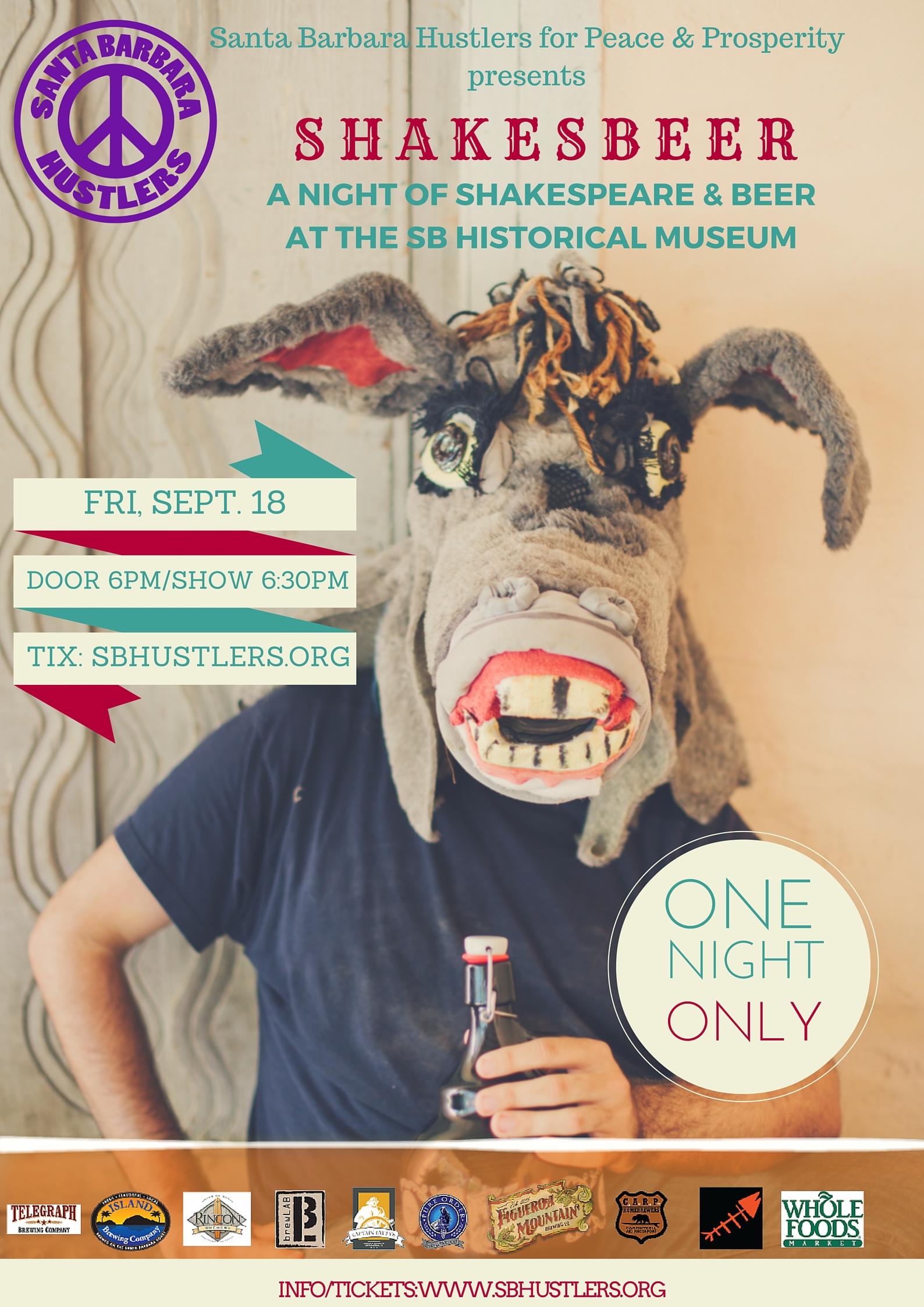
Shakes’Beer (How did Ashland not think of this first?)

ShakesSBeer Poster (1)
All the world’s a beerfest, and all the men and women merely hustlers.

Well, not all the men and women, just primarily four. Zachary Rosen is a Certified Cicerone—the beer industry equivalent of a Sommelier—and on September 18 he’s going to pair Santa Barbara area beers with the Bard of Avon. David Holmes is a theatrical director. Cecily Stewart is a professional ballet teacher. And Matt Turner is the co-founder of the Santa Barbara Hustlers for Peace and Prosperity, an approved project of the Share The Wealth Foundation that provides volunteering opportunities for those interested in becoming more engaged with their local community.
Shakes’Beer, a one-night event hosted at the Santa Barbara Historical Museum, seems more befitting of Ashland, home of nearly-yearlong Oregon Shakespeare Festival as well as breweries Caldera, Standing Stone, and Swing Tree.

The fundraiser is billed as “Shakespeare in the Park meets a beer festival pairing beers with different Shakespearean characters and themes.” With Holmes directing scenes and monologues and Stewart directing “interpretive ballet and an Elizabethan dance session,” Rosen directs the theatre-in-the-round of beers. He styles himself as a specialist in abstract beer pairing events, often combining beer with music and art. He got eight local breweries to design ten unique beers for the event, each one reflecting a different character. For example, Romeo will be liquidly portrayed by brewLAB’s Red Purl Saison (brewed with Perle hops, wormwood, orange peel, and licorice root) opposite Ricon Brewery’s Juliet played by a comely Belgian IPA adorned with hibiscus, vanilla, and orange peel. A beer like Telegraph Brewing’s ode to (Gingered) Julia from Two Gentlemen of Verona and (Bonny) Kate from Taming of the Shrew would certainly break a leg seeing as it’s a Witbier with fresh ginger, pineapple, and Scotch Bonnet peppers.

Even if there are other “Shakesbeer” events such as the Shakesbeer Fest in Stratford upon Connecticut benefitting the American Shakespeare Theatre and another held at The Discovery Center of Murfeesboro, TN, if the SB Hustlers really want to make the world a better place through altruism, they can volunteer to bring their Shakes’Beer at least 650 miles north up to Oregon. I nominate StormBreaker to brew a Trinculo from The Tempest and Baerlic to make Iambic Lambic.

India Silly Ales

IPA or India Silly Ale beer label from All About Beer

ISA label by Brian Devine for All About Beer.

Edit: This story was awarded 3rd place in the “Best Humor/Editorial” category at the 2015 North American Guild of Beer Writers (NAGBW) awards. This same year my book, Oregon Breweries, also earned bronze in the travel writing category.)

Larger breweries get to experiment with new flavors in IPAs all the time in the form of testing new hop varietals, such as Sierra Nevada Brewing Co.’s Harvest series, which recently featured wild hops from New Mexico and ones with good potential from Idaho. An experimental recipe designed to get consumers to try the beer once has done its job after one festival-sized sample. I think the mark of a successful recipe is one that gets consumers to crave the beer and quaff it by the glassful, repeatedly. Neither the brewers nor the consumers want to stop having fun.

But at some point, it gets a bit…silly.

Punker than my wife and kid: a punk looks at 40, or, Season’s Greetings and a Happy New Year.

I never wore a black leather jacket. I never owned a pair of steel-toed boots. I never saw the Sex Pistols because I was one when they formed and barely out of diapers when they disbanded, but I’m punk enough to know that when they reunited after I graduated college that they were fucking rotten sellouts. By the same token or possibly I mean on the flipside, my first car was my mom’s Volvo station wagon. My parents are still married after almost fifty years and the only time I ever ran away from home I left a trail of tangerine peels so they could find me if they wanted, but it ended once I got around the block. I earnestly love Tom Jones’s music.

Punker

Then/Now. Top: Clean-cut Dirty 30s. Bottom: Haggard but Sporty 40s.

The list of ways in which I’m not punk outweighs any itemization of my punk rock credentials. Those include starting, writing, publishing, and distributing a punk rock zine as well as having several years of the Punk Rock Bowling Tournament in Vegas under my belt.

While my stage-diving days are disappearing in my life’s rear view mirror, I hope they’re still down the road and around the bend for my son who is about to turn three. My wife is counting down the hours til she joins me in our forties. She claims she was into punk during her adolescence, but I’m sorry, knowing some of the words to that one Suicidal Tendencies song and loving that one Social Distortion song doesn’t really qualify. This exclusionary way of thinking is, I realize, the intersection of the punk/hipster Venn diagram.

I used to wear a long-sleeve pink button-down shirt with pinstripes in elementary school, selected a pink paisley tie to go with my three-piece, pinstripe suit I wore for my Bar Mitzvah, and in my wardrobe of awesome patterned shirts, the solid pink one nearly garners the most comments. I mainly bring this up because my wife and I are sad to hear our son say, more than figuratively out-of-the-blue, that he doesn’t like the color pink. Only girls like pink. During his transition into toddlerhood while we lived in Amsterdam for the past year, he used to love the color. Gender stereotyping is a learned American behavior. We plan to show him to that boys liking pink is punk. I mean, it’s preppy, too, but for toddler boys, it’s clearly anti-establishment.

What does any of this have to do with anything? Nearing the end of the year I get reflexive. I usually write a year-in-review type thingy. But my goal is to spend very little time on Facebook during the last days of the year and more time in the flesh with friends and family not being distracted by my stupid-phone. But it’s a big one since, as mentioned, I’m now in my fourth decade. I’m older than Kobe Bryant who’s on Year-One of his two-year Senior Citizen’s farewell season.

Since I already put much of 2014 into the hindsight machine during a series of posts outlining the top 10 ways Amsterdam life differs from Portland life (or really how European culture varies from American), here’s the recap in chron order:

1: Bikes and English.

2: Insouciance. Aka: café culture.

3: Playgrounds and parents.

4: Dog citizens.

5: Urban vs. natural beauty.

6: Trains/public transportation.

7: Seasonal creep and spiciness.

8: Beer! (finally)

9: Stroopwafels.

9.5: Koffie/coffee.

10: Violence, mainstream media, and doom. Aka: why we never should’ve left Europe.

So that brings us up to date. I’m very happy that my book is finally done and out and being well-received. I’m also very happy that the bulk of my launch promo events are done and can stop haranguing people into coming out (though naturally I have more lined up for January in Portland, Hood River, and Corvallis so far with the whole state coming soon thereafter). But mostly, I’m very excited about what 2015 will hold. I’m excited for Izzy to start swimming and skiing lessons. I’m jazzed for the music fests we’ll attend wherever they may be but they WILL be. I’m pumped to find out if my forties will be better than my thirties since, honestly, they were better than my twenties. I hope Wifey continues loving her new job at her work. I hope Izzy stays a “goofball,” which he will if nature and nurture have anything to do with it. I hope to find myself in more exciting and beautiful places that I’ve never seen before like I did throughout 2014. (I already know to are on the list: Patagonia and Florida.) And I hope all you guys have a fucking awesome year ahead. Sorry, my punk roots still show sometimes.

So here’s to the newborns, the babies turning into toddlers, the new breweries, the old breweries, new friends, new tunes, new resolutions, and a Happy New Year.

Hoppily Ever After

This isn’t really a Portland Monthly story, but when I was contacted by the same publishing company to write a story about beer weddings, I had to accept if only to say I’ve been published in Portland Bride & Broom. It ended up being a fun story to think about and organize, even though I was given tons of direction on that end. What can I say? I love love. And beer.

Of beer and land

CRAFT by UMH (Under My Host. Even I only slightly get the name) is a new digital magazine by a very enthusiastic publisher named Cori Paige. She’s got the kind of enthusiasm that when she reached out to me via the FB to ask if I might muse about beer for her new digimag, I’d have had to have been some kind of putz to say no.

Since I can’t find the link to the first story I did for Craft, which was a fun exercise in pairing songs about beer with a beer each, here’s the most recent one published online. And I somehow got to put my Religious Studies major (A: don’t ask. B: I double majored.) to work. For the “agrarian issue,” I wrote about the link between brewing and the development of human society through the lands, ages, and religions.